

The catacombs, p.1
The Catacombs, page 1


William Demby
The Catacombs
William Demby was born in Pittsburgh, Pennsylvania, on December 25, 1922, and attended college in Clarksburg, West Virginia, before enlisting in World War II and serving in Italy. He graduated from Fisk University in 1947, then moved abroad to Rome, where he spent the next two decades working as a novelist, journalist, and script translator and screenwriter for the Italian cinema. In the late 1960s, Demby joined the faculty at the College of Staten Island, dividing his time between the United States and Italy. His works include Beetlecreek, The Catacombs, Love Story Black, and King Comus. In 2006, he was the recipient of the Anisfield-Wolf Book Award for Lifetime Achievement. He died in Sag Harbor, New York, in 2013.
Books by William Demby
Beetlecreek
The Catacombs
Love Story Black
King Comus
FIRST VINTAGE BOOKS EDITION 2026
Copyright © 1965, renewed 1994 by William Demby
Introduction copyright © 2026 by Jeff Biggers
Penguin Random House values and supports copyright. Copyright fuels creativity, encourages diverse voices, promotes free speech, and creates a vibrant culture. Thank you for buying an authorized edition of this book and for complying with copyright laws by not reproducing, scanning, or distributing any part of it in any form without permission. You are supporting writers and allowing Penguin Random House to continue to publish books for every reader. Please note that no part of this book may be used or reproduced in any manner for the purpose of training artificial intelligence technologies or systems.
Published by Vintage Books, a division of Penguin Random House LLC, 1745 Broadway, New York, NY 10019. Originally published in hardcover by Pantheon Books, a division of Penguin Random House LLC, in 1965.
Vintage and colophon are registered trademarks of Penguin Random House LLC.
Library of Congress Cataloging-in-Publication Data
Names: Demby, William, author. | Biggers, Jeff, [date] writer of introduction.
Title: The catacombs / William Demby ; introduction by Jeff Biggers.
Description: First Vintage Books edition. | New York : Vintage Books, 2025.
Identifiers: LCCN 2025012351 (print) | LCCN 2025012352 (ebook)
Subjects: LCGFT: Novels.
Classification: LCC PS3507.E5346 C38 2025 (print) | LCC PS3507.E5346 (ebook) | DDC 813/.54—dc23
LC record available at https://lccn.loc.gov/2025012351
LC ebook record available at https://lccn.loc.gov/2025012352
Vintage Books Trade Paperback ISBN 9798217007332
Ebook ISBN 9798217007349
Cover design by Mark Abrams
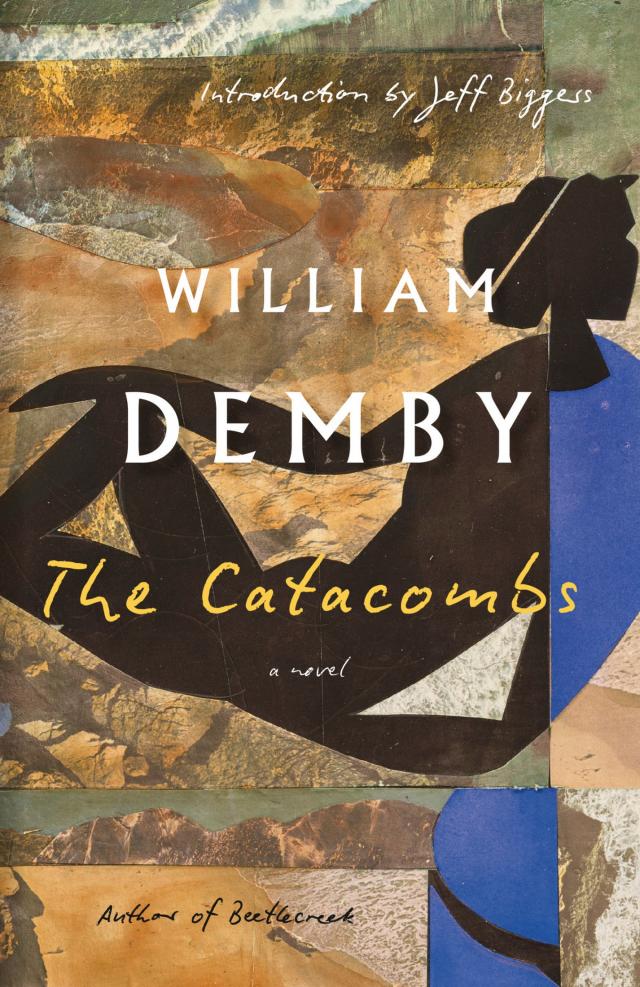
Cover painting: The Intimacy of Water (detail), 1973 by Romare Bearden; Saint Louis Art Museum, Eliza McMillan Trust and Museum Purchase 41:1973; © 2025 Romare Bearden Foundation / Licensed by Artists Rights Society (ARS), New York
penguinrandomhouse.com | vintagebooks.com
The authorized representative in the EU for product safety and compliance is Penguin Random House Ireland, Morrison Chambers, 32 Nassau Street, Dublin DO2 YH68, Ireland, https://eu-contact.penguin.ie.
ep_prh_7.3a_154715802_c0_r0
Contents
Dedication
Introduction to the Vintage Books Edition (2026)
Chapter I
Chapter II
Chapter III
Chapter IV
Chapter V
Chapter VI
Chapter VII
Chapter VIII
Chapter IX
_154715802_
For Tatina
Introduction to the Vintage Books Edition (2026)
When complexity becomes simplicity, when we think everything is clear, we say, now I understand. But the moment it becomes clear, another set of complexities emerges. This is the cycle of history.
—William Demby, The Bloomsbury Review, 2004
William Demby traversed a contrary road in Rome.
In 1947, lugging a trunk of fancy clothes, his clarinet, $75, and a dream to study art and write books, the former GI and Fisk University student followed an acquaintance to Via di San Teodoro, on the edge of the Roman Forum, and stumbled onto a bohemian circle of artists, writers, and neorealist filmmakers still charting their course in the aftermath of World War II.
Fifteen years later, an acclaimed novelist, journalist, and translator for several important Italian film directors, and married to Italian writer Lucia Drudi, Demby took the road out of the Eternal City on the Appian Way, chiseled in 312 BC for the ancient Roman soldiers, until it arrived at one of the numerous catacombs that pockmarked the outskirts of the city with their underground labyrinths of the dead.
In a restaurant across from the catacombs, the guileful author imagined two characters, Doris and the Count Raffaele, having their “last supper.” On the table sat “a fiasco of ruby-red wine.” The tagliatelle arrived in a bowl shaped like “one half of an egg.” The Count asks Doris if she plans to return to America. “I have a feeling I’m going somewhere,” she responds. “I don’t know where.”
In 1962, Demby shared the uncertainty of his muse Doris, an African American dancer and actress caught up in an affair and the limitations of her life with the married Count in Rome. The writer himself struggled to transcend the confines of literary constraints and create a new form for his own work, having labored around the clock for years as the go-to translator for Italian films. He found himself in increasingly difficult financial straits and was faced with the dilemma of returning to his home country. “I sit here at my desk, waiting for Doris to come,” a narrator named Bill Demby types onto the page. “With her approval I am writing a novel about her. I know she has spent the night with the Count, and I am waiting for her to come tell me all about it in detail. In the meantime, I read my newspapers—five from Rome, one each from Turin and Milan.”
Written with the verve and economic prose of a screenplay, unfolding with the august confessions of an expatriate Black writer searching to understand his role in a postcolonial world in turmoil, so begins The Catacombs.
Published to great fanfare in 1965 by Pantheon Books, fifteen years after his celebrated coming-of-age novel Beetlecreek, the book’s experimental style and its vision of an African American looking at the United States and its racial conflicts through a European and postcolonial lens, clashed with the literary expectations of the day. The New York Times critic declared it was not a novel but “an autobiography or pastiche or rag-bag.” It took another four years until scholar and literary critic Robert Bone took the Times to task, recognizing The Catacombs as “one of the two important Black novels of the 1960s.” (The other novel was Paule Marshall’s The Chosen Place, the Timeless People.)
This reissue of The Catacombs, along with Demby’s other novels, recognizes the innovation of the work, its enduring cultural insight, and the timeless quality of his writing, and marks its return to the American literary canon as a classic of that decade.
Spanning two years in the mid-1960s, the American author in Rome weaves the entwined stories of his characters, his interactions with some of the literary and entertainment stalwarts of the day, including a cameo with jazz legend Louis Armstrong, and his own philosophical musings into a “continuous present,” as Bone compared The Catacombs to the writings of Gertrude Stein. The use of newspaper clippings throughout the novel, much like those in John Dos Passos’s U.S.A. trilogy in the 1930s, grounds the story in a seeming realism.
In 2011, however, Demby looked back at his motives to explore a theme or “a soggetto, follow the day’s news, and accept the daily torture of writing not just to produce, but for the metaphysics of what I was doing.” His style is unabashedly experimental; it draws from his long-time immersion in the art world, interlaying a collage of stories like a Cubist portrait of the times.
And what extraordinary times they are. The daily headlines of the Algerian war for independence, the harrowing moments of diplomacy and apocalypse with the Cuban missile crisis, the death of Pope John XXIII and the selection of a new pope in Rome, the death of Marilyn Monroe and her age of stardom, the struggle for civil rights and the landmark March on Washington led by Dr. Martin Luther King, Jr. Demby witnesses them all, both in person and through the news stories. He writes: “[A] strict selection of the facts to write down, be they ‘fictional’ facts or ‘true’ facts taken from newspapers or directly observed events from my own life.” In his hands, these times remain a presence, not a past, and a portal into the underworld of the catacombs.
“[A]ll this antiquity,” Doris says, “all this piling up dead things and dead people on top of each other.” The burial grounds give Doris “the creeps,” as she navigates the forces of men in Rome that only see her aura of “gold and rubies,” and her Black figure as a proverbial “African queen.” She has been forced to take a bit role dancing in the Twentieth Century Fox film of Cleopatra, starring Elizabeth Taylor.
For Demby, the catacombs emerge as a perfect setting for the confounding and conflicting stories of our own times.
“This is a dark depressing time for the novel,” the character Bill Demby writes, “a strangely critical time in my life. It is a Janus-time of looking back and forward, looking forward toward Birth, looking backward toward Death.”
The possibilities o f rebirth, actually, amid the many strands of stories, become Demby’s eternal question.
Even before his arrival on the train to Rome, Demby was no stranger to Italy. As a twenty-year-old soldier in World War II, he hopscotched across the floating pontoons on the edge of the bay of Naples, amid the devastated aftermath of the bombardments, and then found himself in the “tail end” of the column of General Mark W. Clark’s Fifth Army, marshaling to enter Rome. Demby cut his writer’s teeth contributing stories to the Stars and Stripes military newspaper.
The spell was cast on the aspiring writer’s love affair with Italy.
Taking advantage of the GI Bill, Demby attended Fisk University in Nashville, falling under the tutelage of African American scholar and poet Robert Hayden, as well as Harlem Renaissance novelist Arna Bontemps, who served as the school’s librarian. The charged atmosphere of intellectualism, jazz, and gospel enthralled him. It didn’t take long for Demby to return to Rome, however, hankering for the Eternal City, which had become the “most important place to be in those years.” Paris, he dismissed, was for “art and literary poseurs” while Rome presented the “gritty life of the pure artist” as depicted in Roberto Rossellini’s films, such as Rome, Open City, the 1945 classic of neorealism, set during the Nazi occupation of the city.
Demby stepped off the train and plunged straight into this swirling period of artistic and political transformation of Rome. Within days of his arrival, he joined the “Gruppo di Portonaccio,” a lively cadre of artists, writers, and musicians driven by a neorealistic gusto for the recovering city. His own writing began to take shape. In this “revolutionary post-war culture,” Demby once said, his first novel about a provincial town in West Virginia, where he had been raised, “almost seemed to write itself.” In 1950, Demby’s debut, Beetlecreek, was published in New York and almost immediately translated at a prestigious publishing house in Italy, granting him a choice place among the intelligentsia. “It would be hard,” the New Yorker magazine wrote, “to give Mr. Demby too much praise for the skill with which he has maneuvered the relationships in this book.”
Centered around a white carnival worker and a young African American coming of age, the novel is an entirely unique look at fundamentalism and racial hypocrisy. Demby would later tell an interviewer that “Beetlecreek is about the absence of symmetry in human affairs, the imperfectability of justice, the tragic inevitability of mankind’s inhumanity to mankind.”
With the publication of Ralph Ellison’s Invisible Man in 1952, followed by James Baldwin’s debut, Go Tell It on the Mountain, in 1953, Demby joined an emerging generation of new Black writers in the United States. In 1956, he returned to the United States as an expatriate on assignment, writing dispatches on the Montgomery Bus Boycott for The Reporter newspaper. Finding himself in New York City on his return home to Italy, Demby was summoned to literary critic Carl Van Vechten’s home, where he was the last writer to be photographed in the historic series on the Harlem Renaissance.
Life, however, for Demby remained in Rome. Italian weekly and daily newspapers, such as Epoca and L’Espresso, sent him on journalism assignments to Eritrea, Ethiopia, and even Japan. Meanwhile, he became involved with a new wave of filmmakers, including Rossellini, Federico Fellini, and Michelangelo Antonioni, as their translator for the critical English versions. He served as an assistant director on Rossellini’s film, Europe ’51, which featured Ingrid Bergman as a crusading socialite in Rome.
“In Rome,” Demby declared. “I was also beginning to move away from Americans, not for any political or racial reason, but because I was being lionized as a black writer by the Italian intelligentsia of Rome.”
It took years before Demby’s literary imagination led him to the depths of the Roman underground for his next novel, The Catacombs. Anguished by this long break from literary fiction, Demby sat down at his typewriter, declaring that he would not “censor” himself. He writes:
This is a day in March. Here in Rome it is nine o’clock in the morning. The sun has finally come out and my Rotella collages have begun to dance like gorgeous jungle flowers.
Demby refers to his artist friend Mimmo Rotella, whose décollage works, layering and juxtaposing torn advertising posters that plastered Rome, had turned him into a major figure in the cultural scenes in Italy and New York. Inspired as well by his friendship with Toti Scialoja, his brother-in-law and another important figure in modern painting, Demby challenged himself with tackling the literary equivalent of Cubist ideas of multiple viewpoints beyond the traditional realities of time and space. The narrator is not so much unreliable as mercurial; the characters even question the narrator about his motives. Doris announces that she resents being the focus of the novel. She thinks Demby is “kind of weird.” Demby the narrator responds that she is entirely invented—or maybe not. At the famous Caffè Rosati in the Piazza del Popolo in Rome, whose tables and salons were frequented by Demby’s artist friends and the stellar ranks of writers like Pier Paolo Pasolini, Alberto Moravia, and filmmaker Rossellini, one friend asks the writer Demby how his novel is going to end. He tells her how he met Doris.
Meanwhile, the headlines of the day keep piling up, the bloody streets of Algeria reminding the reader that Demby’s view on his own country is informed by the anticolonial movements in Africa as much as the Civil Rights Movement at home. In the process, Demby dispels the starry-eyed American trope that Europe is the place of liberation for people of color. The Count’s sister, a nun in the Congo, writes that in Africa “they speak there a human language the rest of humanity has almost forgotten.”
The Catacombs shattered any social-realist portent to Demby’s work. In 2004, Demby told me in an interview at his villa in Tuscany that “since Catacombs, I think I have been kicked out of the Black Arts race.” He laughed at this reference to the literary movement in the 1960–70s that stressed Black identity and consciousness to challenge the narrow literary norms. Walking me to the edge of a bluff near the village of Consuma, there was an element of sorrow, almost bewilderment, in his voice. It seemed as if his works had placed Demby on the international stage with other literary giants, but somehow ended up displacing him in the American literary arena; like those of his contemporary Milan Kundera, Demby’s idea-soaked novels take place in an exiled realm that detests ethnic provincialism as much as narrow fundamentalism.
For critic James C. Hall, who featured Demby in his book Mercy, Mercy Me: African-American Culture and the American Sixties, The Catacombs established Demby as one of the great antimodernists, on the same plane as jazz titan John Coltrane and his Fisk mentor Robert Hayden. Others considered Demby the heir to Gertrude Stein’s expatriate chronicles. For Demby himself, ironically, the novel and its juxtaposition of fact and fiction in an age of moral disintegration placed him in the avant-garde of postmodernism.
Demby, indeed, returned to the United States, just like his narrator in The Catacombs. In the novel, the character of Bill Demby arrives the day before the March on Washington in 1963, which he will join with his father and sister. Yesterday he was in Rome, he writes, today he marches as part of the “well-groomed, well-behaved revolution.”
And the catacombs and his characters back in Rome? Demby responds toward the end of the book:
“What I mean…is simply this. That everything and everybody, real or invented, characters in books or in newspapers, the ‘news’ itself, stones and broken bottles do matter, are important, if only they are looked at, if only they are observed, just because they are composed of matter. Because everything and everybody, real or invented, characters in books, even the books themselves, even the book jacket and the colored ink on the cover design, is composed of matter and for this reason matters, must therefore breathe in harmony with a single governing law, respond according to its aliveness, its alertness, to the degree that is awake or awakened, to the shifting humors of the wind-tormented involucre of our physical environment, which through Penelope’s law of tapestry, Penelope’s law of changeless change, can, as it so often does, become transmuted into climate and weather, weather peaceful or calm, these wild pregnant storm signals that flash ignored through our minds…”






