

The double standard spor.., p.1
The Double Standard Sporting House, page 1


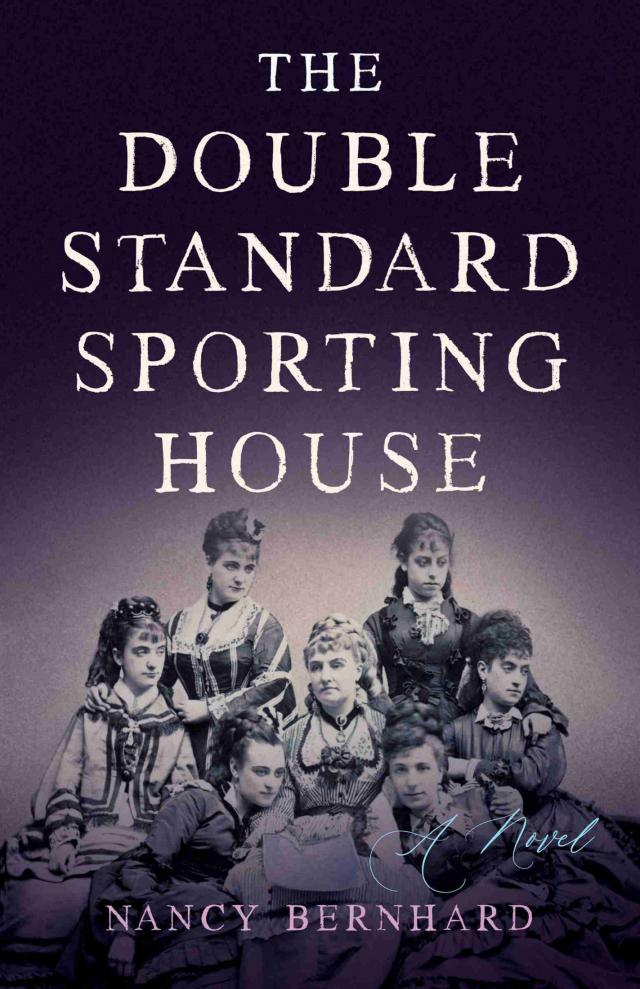
Copyright © 2026 Nancy Bernhard
All rights reserved. No part of this publication may be reproduced, stored in a retrieval system, or transmitted in any form or by any means, electronic, mechanical, photocopying, recording, or otherwise, except for brief quotations in reviews, educational works, or other uses permitted by copyright law.
Published in 2026 by
She Writes Press, an imprint of The Stable Book Group
32 Court Street, Suite 2109
Brooklyn, NY 11201
https://shewritespress.com
Library of Congress Control Number: 2025918195
ISBN: 979-8-89636-052-0
eISBN: 979-8-89636-053-7
Interior Designer: Katherine Lloyd, The DESK
Printed in the United States
This is a work of fiction. Names, characters, places, and incidents are either products of the author’s imagination or are used fictitiously. Any resemblance to actual persons, living or dead, is purely coincidental.
No part of this publication may be used to train generative artificial intelligence (AI) models. The publisher and author reserve all rights related to the use of this content in machine learning.
All company and product names mentioned in this book may be trademarks or registered trademarks of their respective owners. They are used for identification purposes only and do not imply endorsement or affiliation.
to Diana Gordon, first and last reader
For a long time, there was no way for a woman to be both free and good. —Jia Tolentino, 2019
CHARACTERS
Nell “Doc” Hastings—owner of The Double Standard Sporting House, and a free clinic for women
Lavinia “Vivie” Curtis—kidnapped girl whose life Doc saves
Benjamin “Benno” O’Connor—Tammany Hall 16th Ward Boss
Elliott Vanderpoel—theatrical producer
Asa Vanderpoel—editor and publisher of The Standard newspaper
Historical Figures Rendered in the Novel
Peter Sweeny—city chamberlain and member of the "Ring" atop Tammany Hall
George Barnard—Supreme Court Justice of New York
Oakey Hall—District Attorney of New York, elected mayor in 1868
“Diamond Jim” Fisk—financier
Josie Mansfield—Fisk’s mistress
Junius Henri Browne—writer, former newspaper correspondent and Confederate captive
Red Light Lizzie and Jane the Grabber—procurers of prostitutes
Lydia Thompson, Pauline Markham, and Lisa Webber—members of the Blonde Belles Burlesque Troupe
Rebecca Salome Foster—matron of the Tombs
Dr. Marie Zakrzewska—founder of the New England Hospital for Women and Children
At the Double Standard
Ciara and Meg—hostesses known as Mary and Magdalena
Perlie Bixby—housekeeper
Israel Bixby—butler
Bertram Hibberd—chef
Aunty Laure—pastry chef
Willy Schor and Bud Bean—porters
Clemence, Corabelle, Georgia, Marianne, Ruby, Susannah, Sophronia, Tatiana, and Willow—harlots
In New York
Nina, Betsy, Jodie, and Ellen—student nurses at the clinic
Minnie Templeton—nurse trained by Doc, working for Emily Wrigley
Emily Wrigley—owner of several downtown brothels
Vernon Trent—abductor of girls
Wallace Lacy—stage manager at Wood’s Metropolitan Theater
Viola Brison Hill—anti-prostitution reformer
Reverend Albin Birchdale—anti-prostitution reformer
Catherine Farnsworth—Pennsylvania farm girl
Bim Farley—owner of the Wayward Academy
Honey—harlot at the Wayward Academy
Beatrice “Beadie” Korn—owner of The Silk Pillow
In Portland
Wren Hunt—laundress at Portland Hospital
Annalee Warren and Dara Bauer—nurse trainees at Portland Hospital
Christine Pell—nursing supervisor at Portland Hospital
Dr. Jordan—physician at Portland Hospital
Gwindolin Leger—brothel nurse at Rosalie’s in Portland
Part 1
THE RIVALRY PLOT
ONE
September 1868
My day had seen a knotty birth, a giant prolapse, and rampant syphilis. I left the clinic well after dark and stepped into the back garden fretting over the prolapse. There were no good treatments for a wandering uterus, and after hours shaping a barrier from wax, wool, and resin, I was starving. What makes a womb so restless it leaves home like a hero setting off on a quest? What cuts its binds? Female bodies were criminally neglected by medicine, even as they inspired bountiful art, and a robust industry.
In a pragmatic adaptation to such paradoxes of womanhood, at the far end of the garden sat the establishment that funded the clinic. The Double Standard Sporting House served the richest, most discerning men in New York, and we lavished our girls with care. It was the only way for me to practice medicine as I wished, with no one above me and free to patients. Hardly anyone noticed, which was convenient.
The Double kitchen was winding down, and I asked a young maid for a plate. Before I could sit, Ciara appeared in peach silk looking apologetic, followed by a laughing Meg. My dearest friends who ran the house, they usually gave me time to pivot from patients to clients. It cheered me to see them smiling, but I hoped their news would not stand between me and my supper.
Ciara said, “One way or another we’ll look back on this day. Feeling lucky, Doc?”
“Tired, mostly.”
“Well, starch your petticoat. George Barnard is booked for Ruby tonight, and he sent a note. He’s bringing a rookie over now, and would take it as a huge favor if we could find him a girl.”
I liked George, and he was a favored client, but he knew we didn’t take walk-ins. Normally Meg and Ciara would so flood him with flattery he wouldn’t mind. But he was a state supreme court justice, fully owned by the Tammany Hall political machine and its boss Bill Tweed, and they were entertaining his request. They weren’t cowed; there would be an angle.
Tammany itself is difficult to explain, being a monster with many heads. It began a century before as a political club and now ran like a warring tribe. In the fall of 1868, they were poised to capture the mayor, governor, legislature, and supreme court of New York. We had several clients like George in its top echelon, amiable men who stole outlandishly from the city by padding contracts. They dispensed some fraction of the plunder to the needy in exchange for votes. This vast mob was seizing all the city’s levers of power.
“Do we have a girl for George’s mystery friend?” I asked, pouring a glass of cider.
Twinkling with mischief, Meg said, “For a price.”
“Who is he?”
Ciara said, “The note didn’t say, but the messenger came from Delmonico’s.” This was the city’s finest restaurant.
Meg looked me in the eye. “George is supping with Peter Sweeny.”
Well, well. The Double Standard just kept rising with the city’s reckless growth. The city chamberlain, second or likely first most powerful man in New York, the wizard of Tammany’s epic theft, Peter Sweeny was famously odd and prickly, and a devout Catholic. I flashed them a look of wonder and worry. A high-ranking and volatile client put us at risk of ruinous public scrutiny, but—and here was the angle—would also bring access and influence.
“Little bugger’ll need a world-class nickname,” said Meg.
“They used to call him Spider at Harry Hill’s. Maybe he’s handsy,” said Ciara.
I’d heard him called Brains and Bismarck. “What does Bismarck do for fun, I wonder.”
A pious man either abandoned or punished himself in a brothel’s pleasures. And how did one square churchy obedience with historic theft? I’d also heard Sweeny held renowned grudges. “Why the sudden interest in sport?”
A porter called from the stairs, “Miss Ciara?”
As we went up, I asked which girl they intended for him.
“It’ll take some juggling, but we thought Sophronia,” Meg said. This was our girl of the moment, an hourglass brunette with a guileless face, good with a novice.
George Barnard stood alone at the salon piano, noodling a sonata.
“Your Honor.”
“Evening, Doc, ladies.” He was tall with dark curly hair and a particularly squirrelly version of the requisite moustaches drooping down the sides of his chin. He took my hand in both of his, and said his guest preferred to come straight to a private room.
Naturally Sweeny feared being seen at the Double, though many men got a charge from darting up the stairs. “He can come directly to the library.”
Ciara went to find Sophronia, and Meg and I crossed the hall to wait for George to fetch his friend. She whispered, “Saint Débauche,” and then, “Pope Pius the Libertine.”
I said, “I imagine he’s not so much embracing sport as he is falling into temptation. The Reluctant Pervert.”
“Mommy’s Little Miscreant. Tinpot Degenerate.”
We put on our most pleasing faces as he slunk into the room and waited until the door closed to doff his hat and cloak. For all his fearsome intelligence, Peter Sweeny looked shy. Nearly my height of 5 feet, 8 inches with sloped shoulders and thick black hair stabbing in all directions, he might have been handsome given another soul within, but the man w as wooden and remote. I began to see how he squared God with fraud.
George introduced us, and I let Meg lead the conversation, as she was an auburn-haired goddess in a gorgeous evening gown, and I was a middle-aged medic in a dirty shirtwaist. Taking a bourbon, Sweeny answered each of her questions with a single syllable.
Ciara knocked and entered with Sophronia, who wore an azure gown with a sweetheart neckline. Sweeny missed that most stunning décolletage while his eyes flew between Meg and Ciara. We called them the twins, but clients knew them as Mary and Magdalena. Given that he showed not one speck of humor, let alone about his religion, I said, “You’re not seeing double, sir. These are our house hostesses Meg and Ciara, to whom you can appeal if you need anything at all.”
Ciara noted my use of their names and introduced Sophie, who curtsied to good advantage and sat next to him. He froze, but her soft words soon put him at ease.
And then I remembered something particular. Sweeny had been elected district attorney in the mid 1850s but resigned early, having broken down in front of his very first jury. The man did not like eyes on him. I led George away to the draped window.
He murmured, “I mentioned the advantages of a private house, and he stood up, ready to go. I hope you’re amused.”
“Does he often take sport?”
“Never, to my knowledge.”
Sweeny’s attention had at last landed on Sophronia’s figure and the elegant finger tracing her collarbone. He coughed and recrossed his legs.
Ciara joined us at the window. “Ruby awaits you upstairs, George. I can take you to her, or bring her here, as you prefer.”
“All right there, Sweeny?” he called.
Sweeny dismissed him with a flick of the hand, so George and I followed Ciara out. I left them all to business and returned gratefully to my supper, curious if Peter Sweeny would turn out to be a one-off, a friend, or a difficulty. He was well worth cultivating, but the closer we grew to the Ring atop Tammany, the more implicated we became in their corruption and thievery. I tolerated the trespasses to law in brothel work, as women had so few options and respectability was so rank with hypocrisy, but this was different. Tammany was careless, and to be its favorite risked making me its captive. I would guard my independence even as the girls beguiled Sweeny.
Halfway through my cold squash and beef, I heard Ciara on the stairs again. She said, “Benno’s here, asking for you.”
I closed my eyes and prayed for patience. Benjamin “Benno” O’Connor was our new ward boss, the local Tammany muscle several rungs below George and Sweeny. “What does he want?”
“He asked for Ruby. When I told him she was busy, he demanded you. We can’t manage a second walk-in.”
“Is he sober?” I rushed through a few more bites of food.
“I think so. Mostly.”
I said, “Peter Sweeny is settled upstairs, yes? He really did not want to be seen.” He and Benno likely knew one another. We had two staircases and an array of dodges.
Benno had come up on the docks and the Big Six engine of Tweed’s fire company, the type to sit on a hydrant watching a house burn before he’d let a rival company put it out. Tweed had gifted him our 16th ward, which spanned the docks and our fashionable uptown vice district, Satan’s Circus. Fifty houses crowded the blocks between Twenty-Third and Twenty-Seventh west of Broadway, most of them far out of his reach until lately.
My plan was to be gracious and useful. Our power, which Benno had yet to learn, rested partly in charm, but mostly in secrets.
Ciara had settled him in the library with a beer, a porter at the door.
“I like that girl Ruby,” he said, like he expected me to produce her before entering the room. He didn’t stand. His square bald head sat on a columnar neck, inclined to fight.
“She’s a peach,” I said, sitting. “But Benno, our girls are booked weeks in advance for the whole night. Forgive me if you expected to see her, but that’s not possible.”
“Sure it is. I had her before.”
His face was straight malice, with dead eyes, a thrusting jaw, and psoriatic skin. I guessed his teeth hurt. Time to appease him as best I could. “During our monthly Saturday parties, we have more flexibility. I don’t mean to be rude or disrespectful, and I am sorry, but a gentleman has long since paid for the pleasure of her company for the whole evening. It would not do you or me any good to interrupt their arrangement.”
“They see only one guy a night?” He cherished his prerogatives but was enraptured by money. Local Tammany bosses in each of the city’s twenty-one wards took hefty graft from every enterprise including brothels, and bought the police. I found myself in the strange new position of intimate to titans, but servant to this hoodlum.
“There’s a steep entrance fee, if you will, and then over the course of the evening they eat a very fine meal, and drink a lot of very fine liquor.”
He grunted. “You got faro or dice?”
“No, we don’t have gambling at the Double Standard.”
“Why not? That’s easy money.”
Perhaps he had come to renegotiate terms. We paid the last boss a steep, round $1500, or about 7 percent of our monthly income, which was half of our profit.
I said, “Gamblers fight. They throw chairs and slap girls around, and it ends up costing more than it brings in. Plus we’re not that kind of house.”
“Well,” he said, threats being his first language, “maybe now you are.”
I had long experience delivering unpleasant news. “Did you know that I come from the street, Benno? Same as you. The house is fancy, but I’m no snob.”
“Yeah, but I heard you were never a whore.”
He smeared me with the word anyway. Men often found it suspicious that I profited from prostitution as a man did, without participating. Some girls found it disloyal.
“That’s true,” I told him, “but I still started with nothing. Less than nothing.”
“Why not?” He looked me over. He was near my age of thirty-six, double that of most harlots. Pretty and feminine enough when I was young, my thick brown hair and hazel eyes my best features, I was tall and had the habit of authority. I didn’t mince my steps or drop my gaze, and had a scar just under my jaw suggesting a violent history.
“Be a harlot?” I smiled. “I stick to what I’m good at. Listen, our clients arrive with the kind of cash a winning gambler throws around. They might go downtown on a different night or play vingt-et-un somewhere else, but sometimes they want sophistication and refinement. In our part of the market, the absence of gambling is an asset.”
He turtled his chin. “That’s no fun.”
“There are many kinds of fun, my friend. Our girls are in-comparable.”
“Manzoe’s Academy and the Hotel de Wood have dice.”
These were other fine houses in the neighborhood, but they were public, admitting anyone who could pay. We required appointments and referrals, most of which came through the Union League and University Clubs. I said, “We’ve been booked solid for seven years.”
He looked around at the mahogany bookshelves and did a double-take at a marble bust of Eulalia, a teenaged martyr. I put a hand to my collar, which brought a porter into the room with another glass of beer.
Benno watched the boy, who never raised his eyes, and said, “How many people work here?”
“We have nine harlots at the moment, plus two hostesses, and about thirty staff. A brothel runs like a small hotel,” I told him. “Dishes and laundry.” I left out the nearby stable and various other ventures.
The pressure would be on him to deliver votes and to expand his own interests so he could dispense jobs and favors in the Sixteenth, something I knew well. I said, “It took a while to build all this up. Years, really. Imagine where you’ll be in a decade.”
His brow dropped. “How’d you get this property?”
It began as a weedy lot purchased on impulse during the Panic of 1857 when for once it was useful to know a gambler: prices were low, and he was desperate. The lot spanned Twenty-Fourth and Twenty-Fifth Streets between Sixth and Seventh Avenues. On it now sat twelve tidy brownstones, six facing north and six south with a big garden between.






