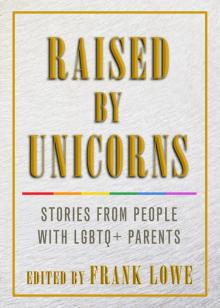
Raised by unicorns, p.1
Raised by Unicorns, page 1


RAISED
BY
UNICORNS
Copyright © 2018 by Frank Lowe.
All rights reserved. Except for brief passages quoted in newspaper, magazine, radio, television, or online reviews, no part of this book may be reproduced in any form or by any means, electronic or mechanical, including photocopying or recording, or by information storage or retrieval system, without permission in writing from the publisher.
Published in the United States by Cleis Press, an imprint of Start Midnight, LLC, 101 Hudson Street, Thirty-Seventh Floor, Suite 3705, Jersey City, NJ 07302.
Printed in the United States.
Cover design: Scott Idleman/Blink
Text design: Frank Wiedemann
Author photo: Matthew J. Wagner, Fine Photography
First Edition.
10 9 8 7 6 5 4 3 2 1
Trade paper ISBN: 978-1-62778- 256-2
E-book ISBN: 978-1-62778-257-9
Library of Congress Cataloging-in-Publication Data is available on file.
TIME article excerpts from “I Was Ashamed and Silent About Being Raised by Two Women” provided by, and used with the permission of, Time Inc.
TIME article excerpts from “Why Children of Same-Sex Parents Should No Longer Feel Invisible” provided by, and used with the permission of, Time Inc.
CONTENTS
EDITOR’S NOTE
THE CURIOUS CASE OF A STRAIGHT BOY COMING OUT
Ariel Chesler
I AM NOT AN ALLY
Jenny Gangloff Rain
ONE COIN, TWO SIDES
Persis Ticknor-Swanson
Calvin Ticknor-Swanson
LEARNING TO DANCE
Kate Hillyer
THE FAMILY THAT JUST HAPPENED
Olivia Rudis
THROUGH RAINBOW-COLORED GLASSES
Eric Tracy-Cohen
THE WAY IT WAS FOR ME
Kellen Kaiser
LEARNING TO LOVE
Mary Holland
TWO HENS AND A CHICK: MY TEENAGE LIFE WITH TWO MOMS
Mikayla Denault
THE WOMAN WHO CANNOT REFUSES TO FRENCH BRAID HER HAIR
Emily Grubbs
MY DAD IS A DRAG . . . QUEEN
Ryan Murphy
“I KNOW YOU ARE, BUT WHAT AM I?”
Lara Lillibridge
CHANGING THE DEFINITION OF GAY
Rebecca Gorman
BEAUTY AND THE BUTCH
An Interview with Joe Valentine
RESOURCES
ABOUT THE AUTHOR
I dedicate this book to the pioneering LGBTQ+ parents that inspired me to follow in their footsteps, and to their children that continually inspire and amaze me.
EDITOR’S NOTE
HI, I’M FRANK LOWE, a forty-one-year-old divorced gay dad. Some of you may know me from my snarky, acerbic Twitter persona “@GayAtHomeDad.” Others may be familiar with my writing for publications such as Huff Post, Gays with Kids, and The Advocate online, among many more. When I started tweeting in 2012, my original intent was to blow the roof off gay parenting stigmas. I used humor to diffuse what was a newer concept then (times have changed in five years), and it worked. I amassed over a hundred thousand followers who can now say they know at least one gay dad.
I used that platform to segue into what I really wanted to do—help others in the LGBTQ+ community, specifically youth. Through my writing, I opened my life wide open and gave people a true perspective into what it means to be a gay parent. Most readers have discovered there’s not really a big difference. Sure, I might put a little more flair into styling my kid’s hair, but that’s about it. Needless to say, my son is my life, and I’ve dedicated myself to him becoming the best human possible.
Growing up as a gay kid in the 1970s and 1980s, I never viewed fatherhood as a possibility. Everywhere I looked, images of the LGBTQ+ community were hyperbolic and superficial. I didn’t have an idol to admire because “gay” was considered a defect. Much to my surprise, there were pioneers and always have been; brave LGBTQ+ individuals who ignored the criticism and became parents when no one dared. To them I will always raise my glass, and extend an appreciation that goes beyond words. But I can assure you, the fight is still raging. There is much work to be done, and many eyes that need opening.
Six million and counting. A huge number, right? Hard to believe when you consider we’re discussing U.S. citizens who have at least one LGBTQ+ parent. But that’s reality. These people can’t even type “my moms” or “my dads” into Microsoft Word without it wanting to add an unnecessary possessive apostrophe—i.e. “my mom’s” (try it, you’ll be amazed). Whether they want to be or not, they are an extension of the LGBTQ+ community. Terms such as “queerspawn” have been used to describe them, but personally I wouldn’t refer to my son as that. In fact, I don’t think he needs a label. He can be what he wants to be.
When people discover that I have a son, the first question is always “how?” I understand the curiosity and happily volunteer the truth. “My now ex-husband and I adopted him from birth, locally.” That sums it up very succinctly, and allows me to elaborate, should I choose to. The long version is that we got on the adoption list, were chosen by our birthmother six weeks later, and she had our son nine days after that. It was a whirlwind of happiness and new responsibilities. My joke has always been that straight couples get nine months; we only had nine days.
Prior to our son’s birth, I longed for any kind of information about gay adoption and raising a baby. It was 2009, and there were a few popular options. Every night, I’d be awake until three A.M. reading, to absorb all I could. Eventually I wanted something I was unable to find: the viewpoint from kids with LGBTQ+ parents. Now, that isn’t to say there weren’t choices available (there were and are). I just couldn’t locate them easily, and time was not on my side.
Before we knew it, our son Briggs arrived and my priorities shifted immediately. I was fortunate enough to be a stay-at-home dad (hence the infamous Twitter moniker), and my entire life revolved around him. I thought less and less about, “What will he think about all this eventually?” and focused more on “How can I currently improve his life?” Not to say I wasn’t empathetic to him, things just changed once he came along.
Fast forward to now—2018—he’s eight, and I’ve never been more proud of a human being in my life. He’s been an inspiration to me in infinite ways, including what you’re reading right now. I was gifted with this fantastic opportunity, and can finally give voices to those who have been relatively silent or swept under the rug.
“Raised by Unicorns” is obviously a take on the old adage “raised by wolves,” and I couldn’t find it a more fitting title. Not that I necessarily consider myself a unicorn (well, okay, sometimes), but the LGBTQ+ community comprises unique individuals and therefore, it seemed entirely appropriate. My goal was to present a diverse anthology to you, full of different life experiences. These stories run the gamut, and that is the beauty of it all. You may notice that this book is a little heavier on the L and G, but I feel that is a snapshot of the time we are living in and is constantly evolving. I envision this as a first volume, and want to revisit it every decade or so to document the inevitable changes and progress.
All I hope you take away from this book is empathy. These people are beautiful souls who have faced adversity since they were born. Some of the stories might be what you imagine, and others will floor you. Regardless, in a century or so, this will be history, and I thank you for being part of it just by taking all of this in.
TO START US off, here is a note from my son, as he is too young to write a chapter:
Hi, my name is Briggs. I’m eight-and-a-half-years-old and in the third grade. I have two dads and they are very nice to me. My dads help me with things. I like that I have two dads. They don’t live together anymore, but that’s okay—I still see them the same. I get two Christmases now. I call one dad “Daddy,” and the other one is “O’Daddy.” I talk to them every night. I love playing video games with Daddy and playing catch with O’Daddy. I love my dads very, very much!
THE CURIOUS CASE OF A STRAIGHT BOY COMING OUT
ARIEL CHESLER, age 39
AS A FATHER to two young daughters who are influenced by Disney movies and other common culture, the topics of love and marriage come up often. But when my daughters discuss marriage with me, they sometimes forget our previous conversations on the topic.
“Isabella says only a boy can marry a girl,” one of them reports to me one night at dinner.
“That’s not right,” I respond. “Two of your grandmothers are married to each other! “That was your first wedding,” I tell my older daughter.
“Oh, right,” is the response, and we quickly move to the next topic. So simple. No big deal. A shrug. A whatever. No, in truth—a revolution.
Sometimes when things move fast it is too easy to forget what came before. Today, when people talk about marriage equality or children being raised by same-sex couples, it seems they can’t even imagine or comprehend how it was. Presently, there are many LGBTQ+ couples who are married and raising children. At any one time, there are almost 100,000 LGBTQ+ couples raising children. Just one type of the many diverse families we have in our country. But the reality of children being raised from birth or infancy in two-parent LGBTQ+ homes is a relatively recent phenomenon.
Television shows like Modern Family, and This Is Us, children’s books like Heather Has Two Mommies, or The Family Book, have contributed to normalizing these families, these relations hips. In so many ways, the kids of same-sex couples today are so much more all right than I was because they can see themselves in books and on screen, which both validates and changes how they view themselves. They also see their families protected equally by our laws. In many different facets, we have reached a point of what appears to be acceptance, equality, maybe even love.
But please know, Dear Reader, that before acceptance there was hate and stigma. And before that, attaining equality, legal rights, or recognition was not even a dream. Instead, there was invisibility and shame. Perhaps people forget because the ecstasy of recent justice blinds them, or perhaps it is a naive belief that because the nation’s highest court has recognized same-sex marriage as valid and equal that the war is won, and all that is the past is behind us. But for those of us who were among the first to be raised by LGBTQ+ parents, we cannot forget because we carry scars in the innermost places of our hearts. So please, then, friend, let me share my story of being raised by two women in the 1980s. Let us remember it like it was.
THE FIRST THING you must know about is my shame about being raised by two mothers. Why? Because shame is what has stalled my writing these very words you are reading. Shame has made me pause and pull away and doubt and block my thoughts. Shame is what still makes it more comfortable to keep this story locked away, private, unshared. Shame is what silenced part of my childhood. And, once learned, shame stays with you for a very long time. This is the point of Pride events and Pride marches, isn’t it? Showing pride in ourselves and in our families is the opposite of and the antidote to shame, just as visibility is necessary to combat invisibility. Speaking our truth and sharing our stories and doing so with pride is the path to freedom. But, this was not something I could do as a child.
The second thing you must know is that before my shame about having two mothers, I had a deep and ever-present longing for my father. That longing is also still with me and I’m always looking for him. Sometimes, I think I see my father as I walk down crowded New York City streets. I see a man and I am sure that’s my father’s hair or his stride. It’s never him. I keep walking.
I was born in Manhattan in January 1978. By all accounts, my father was greatly involved in raising me during my first couple years of life. He fed and changed me, bathed me, and woke in the middle of the night to tend to my needs. Some of my earliest memories are images of my father and Central Park. I see branches and leaves, feel his hand grasping mine, and hear his accented voice speaking to me in Hebrew.
My mother and father divorced when I was two, and I continued to live with my mother in Brooklyn and see my father on alternate weekends. My mother—a trail-blazing feminist author, psychologist, and professor—was often unavailable to me, and by necessity left me in the hands of nannies and babysitters, and my grandmother. My father’s absence from my home and my mother’s inability to be more present resulted in my constant thirst for a hands-on parent.
Each time I was to see my father, I sat for countless hours looking out the window of my Brooklyn home, waiting and hoping for him to arrive. He was always late, so I watched the pavement and the pass-ersby, jumping at each car that slowed near my house, thinking it could be my father. Weekends with him were always fun, but they inevitably ended. It was never enough. I needed him for the daily grind, to fulfill the challenging, never-ending role of a parent.
I also longed for a closer connection to my father’s family, my extended family in Israel, including my grandparents, aunts, and cousins. My mother had a strained relationship with her brothers and little other family, and so my connection to her blood relatives was inconsistent and insufficient.
Because my dad was not involved in my life in as deep a way as I desired, I always fantasized about his returning to live with me. Often, I couldn’t understand why his return was not possible, and I longed for my parents to love each other and be with each other again in the way I’d seen in the black and white photographs taken at the time of my birth.
My father’s absence formed an unfillable hole, an insatiable hunger. I was in so much pain and angry at my dad for not being there in the ways I wanted. I didn’t need any dad. I needed my dad. And nothing could replace him.
Still, while being a child of divorce was painful, it was not uncommon and it was not something I had to hide. Other children had absent, distant fathers. Other children only saw their fathers on weekends. Some children I knew had step-dads. Divorce was represented in the popular culture of the time. Just think of the acclaimed 1979 film Kramer vs. Kramer, which portrays a divorce’s impact on a young boy. I also recall reading Megan’s Book of Divorce, a children’s book by Erica Jong, which normalized my status as a child of divorce, and helped me work through the pain and frustration of not having my father in my home.
As a child with a father absent from my home and an incredibly busy single mother, the last thing I wanted was to share my mother with someone else. It was hard enough for me to accept all the time my mother spent in her home office writing, and all the meetings and events she had to attend.
I had a habit of crawling into my mother’s bed in the early morning hours. That was my space, my sacred time with her. One day, when I was five years old, I made my way to her bedside and was shocked to see a second figure in the bed. It was a woman, the woman who became my mother’s first long-term girlfriend and my second mother. But, in that moment, for me she was an interloper, an obstacle, an unwanted presence. But she didn’t go away. To the contrary, she joined our household.
For a time, I was cold and distant. I wanted nothing to do with that woman. She certainly wasn’t my father and I had not agreed to have her live in our home. I became nasty and mean and started name-calling. Unlike my mother, she swiftly disciplined me, and laid down ground rules about my behavior. I listened.
Her name was Patricia. And as she became a permanent fixture in our home, and as we grew to know each other, my position changed. Pat was there every day, after all. She was there in the mornings to make me eggs and English muffins. She was there after school to bring me to activities. She was there in the evenings. She took me to see her parents and to play with her siblings’ children on weekends, children I came to consider my cousins. In fact, she was there during all those moments I had been looking for a second parent.
We had meals as a family, and went on vacations to Disney World. Pat taught me how to dance to Michael Jackson and she and my mother encouraged me in all my interests. Pat comforted me when I needed it and disciplined me when I needed it. She empathized with my longing for my father. I saw her express love for my mother, and we became a family. Eventually, I called Pat my “other mother.”
Also, Pat gave me, a Jewish-American boy, the greatest gift of all: Christmas. I grew up celebrating Hanukkah, singing all the requisite songs, and lighting the menorah all eight nights. But, Christmas trees and presents excited me. So you could imagine my delight when Pat, who is Italian-American, brought those things into our home. “It was a dream come true, the tree towering over everything save the forest of bookshelves that were its backdrop, bearing ornaments and lights and presents, all forbidden fruit that I was allowed to touch and smell and open. The tree was about custom, not religion. It was about warmth in the winter and complementing our Hanukkah nights, and mostly about making a young boy happy.”1
During Christmastime, I would slide down the bannister of our Brooklyn brownstone, and rush for a pile of presents beneath the tree. It was with pure glee that I broke into boxes containing He-Man, G.I. Joe figures, and Nintendo games. I would then proudly take Polaroids of myself in the aftermath, beaming, surrounded by my treasure. We would enjoy Italian Christmas feasts with Pat’s family. Tables were filled with calamari, fried shrimp, and the pasta dishes I will crave forever.