

Fat lad, p.1
Fat Lad, page 1


Imprint Page
First published in 1992 by Chatto & Windus Ltd
Published, with additions, in 2008 by Blackstaff Press
This edition published in 2012 by
Blackstaff Press
4c Heron Wharf, Sydenham Business Park
Belfast BT3 9LE
with the assistance of
The Arts Council of Northern Ireland
© Glenn Patterson, 1992, 2008
© ‘On Reading Fat Lad’, Robert McLiam Wilson, 2008
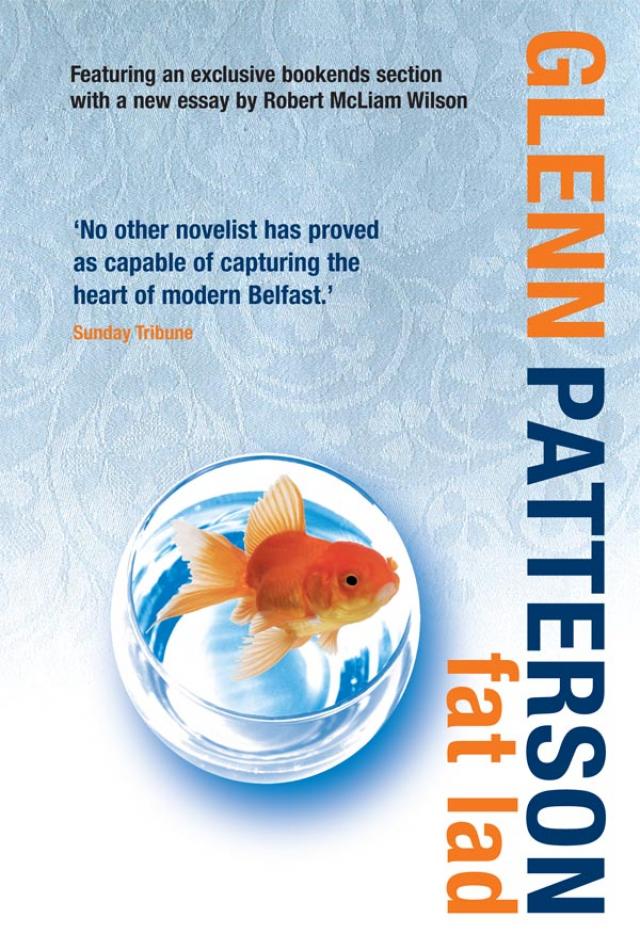
© Cover image of goldfish, Getty Images
All rights reserved
Glenn Patterson has asserted his right under the Copyright, Designs and Patents Act 1988 to be identified as the author of this work.
Cover Design by Dunbar Design
Produced by Blackstaff Press
A CIP catalogue record for this book is available from the British Library
EPUB ISBN 978-0-85640-117-6
MOBI ISBN 978-0-85640-123-7
www.blackstaffpress.com
www.blackstaffpress.com/ebooks
Praise for Fat Lad
‘humane, wise, funny, absolutely contemporary’
Guardian
‘A triumph. Fat Lad may be the finest novel written out of Ulster in twenty-five years.’
Scotland On Sunday
‘In its complexity, humour, impatience and incompleteness it is unmistakably authentic.’
Observer
‘No other novelist has proved as capable of capturing the heart of modern Belfast.’
Sunday Tribune
‘told with grace, with warmth and ineffable lightness by a writer in full love and knowledge of his city’
Robert McLiam Wilson
About Glenn Patterson
Glenn Patterson began his first novel, Burning Your Own, while studying at the University of East Anglia, where he was taught by Malcolm Bradbury and Angela Carter. In 1989 he was appointed writer in the community for Lisburn and Craigavon by the Arts Council of Northern Ireland and started work on his second novel, Fat Lad, which was published in 1992. A year later he went to University College Cork as writer in residence, and the year after that became writer in residence at Queen’s University Belfast. Black Night at Big Thunder Mountain was published in 1995 and was followed in 1999 by The International. His fifth novel, Number 5, appeared in 2003, his sixth, That Which Was, in 2004. A collection of his journalism was published in 2006 under the title Lapsed Protestant. His most recent novel is The Third Party (2007), set in Hiroshima. A first full-length work of non-fiction, Once Upon a Hill, was published in 2008. Glenn’s television work includes documentaries for BBC, RTÉ, Channel 4 and Granada. He teaches creative writing at the Seamus Heaney Centre for Poetry in Queen’s University Belfast and is a member of Aosdána.
Dedication
For Colette
1
– Goldfish? My granny had a goldfish once. It drowned.
The crack that lost him his virginity. Indirectly. A dreadful joke, if joke you could even call it, for there was no more to it than that: a drowning goldfish and a Northern Irish voice. And it was the voice, raucous above the babble, turned her head in the first instance, before the image congealed and made her smile and she began her evening-long drift round the tables of the Union bar towards its source. He watched her approach, knowing full well what lay ahead, amazed at how easy it was, when it came to the bit, to make the little betrayal in pursuit of success: it’s the way I tell them; the green and white minstrel. Amazed too, though not for the first time since arriving in England a fortnight before, at the unexpected effects of this thing coming from his mouth, this Belfast accent, his sister’s childhood nightmare. A stigma turned distinction.
Hours later, after last orders at the bar and drinks in someone’s room and a smoke in someone else’s, after faltering sex by the light of a reading lamp turned to the wall, it was the voice she came back to:
– I could just lie here all night listening to you talk, she said, confirming what he had already thought, while putting the dampener on any hopes he might have had of trying to improve on his initial, dismal, coital efforts.
Her name was Kelly Thorpe, a languages student from Leicester: though my great-grandparents on my mother’s side were from Ireland, which is where I get Kelly. At Christmas she sent him a card in Belfast, with an airmail sticker in the top left-hand corner of the envelope. But by that time, the compromises of his fresher weeks long forgotten, he had fallen in with the Expats, a group of jaundiced exiles, sworn to renounce their birthplace and all its works, and Kelly’s misconception about the countries’ postal relations was no more ludicrous to him than the posturings of the earnest boys who stood every Thursday on the steps of the Union building, with their Harringtons, number one crewcuts, and armfuls of Troops Out papers, bellowing in best Home Counties accents:
– Support the revolution in Ireland!
Hugh McManus, final-year law, guiding light and ex-iest of all the Expats, had harangued them, solo, one famous rainy Thursday, challenging them to define their terms – What revolution? What Ireland? – and cutting to pieces each glib formulation with a flourish of his free hand (for one or other of Hugh’s hands was invariably entangled in the straps of a garish and voluminous vinyl shopping bag), till they, their hair sticking up like a teddy bear’s sucked fur and the thighs of their jeans wet where the rain had coursed down off the plastic sheets protecting the papers, were reduced to shouts of Paisleyite! and Fascist! Hugh McManus. The son of Belfast’s foremost Catholic solicitors. The brilliant Hugh McManus, shot to death last year at age twenty-nine by a gunman, or gunmen, unknown, following his successful defence of Father Fiacc, the Liverpool priest (dubbed Father Fear by the tabloids) accused of plotting to assassinate the Environment Secretary on a visit to a Merseyside garden fête.
Drew looked at his reflection, double-exposed (speccy eight-eyes) in the aeroplane window. Where did Hugh come from all of a sudden? The lips in the window rewound at speed and tracked in on the word goldfish. That bloody goldfish. Eight years and more after he could last remember having given it a thought, it had turned up in his dreams the previous night and was still there when he awoke this morning, going round and round in his brain as monotonously and pointlessly as it had used to in its bowl.
Grandpa Linden, who Drew knew only from photographs and yarns such as this, had brought the goldfish home with him a month or two before he died.
– Where’d you get it? granny asked.
– A wee man Big Alec knows is selling them cheap.
There was always some wee man Big Alec knew selling something cheap. No questions asked, of course. Grandpa Linden asked none then, but from the day and hour it came into the house it was clear to his wife that that goldfish was never bred for life in a bowl.
– They’re a special strain, grandpa hazarded. From Africa.
– From somebody’s pond up the Antrim Road, more like, she said, peering at the thing through cloudy water.
It was huge. Even at that early stage swimming backwards and forwards was out: round and round was all it could manage, or every once in a while, with a huge splosh as it performed a laborious about-turn, round and round in the opposite direction.
– We can’t leave it in there, it’ll die.
But they did and it didn’t; not for a good many years anyway and certainly not in the way Drew’s grandmother had in mind. But then, who ever heard of a fish drowning? Or rather, to give the thing its proper name, being drowned? For even when the goldfish finally did go (early April, mid-seventies, while Granny Linden took an Easter week in Portrush), it did not go of its own free will. Drew had pushed open the bathroom door one evening to find his sister Ellen kneeling on the oval mat, her arms plunged into the bathwater and the empty bowl on the lino beside her. She turned her eyes towards him briefly, then looked away into the water.
– Get out, Drew, was all she said and when he saw her next she was at the boxroom window, pressing her face to the glass, causing ripples of mist to expand and contract about the imprint of her lips. Again and again, expanding and contracting, till the curtains were yanked together and the ripples contracted one final time in a slow-dying grin.
The fasten seat-belt command pinged red as the plane emerged from the mizzle and banked right, putting stern dark hills between itself and the lough shore on the descent into Aldergrove. And only then did Drew accept what was happening. Only then, despite everything that had gone before in the six chaotic weeks since he had read of the vacancy on the staffroom noticeboard – the letter of application, written on an impulse, then and there, the interview, the discussions, turning to rows, with Melanie, even the week-long visit to arrange a flat the month before (his first visit in four years and the only one since he graduated not occasioned by a funeral); all had been conducted in a bubble of unreality which popped now with the drop in cabin pressure.
The plane roared in towards the runway, hitting the tarmac with a bump. Impact of incompatibles. It reared up, as though affronted. Forget it, Drew felt like saying. Let’s turn round. But even while the thought was forming the plane was adjusting its speed and the second time there was no bump and he was back.
Only a year, he promised himself. Only a year.
No one was watching for him from the viewing tower, because no one knew when to expect him. Drew took renewed heart from his foresight in not phoning ahead. Start as you mean to go on. The less he depended on the family the better. He was nearly twenty-seven, after all, and well use d to looking out for himself. He had come back, he thought now, and he hadn’t come back. For how could he be said to have returned to something that wasn’t there before? The Belfast he left, the Belfast the Expats forswore, was a city dying on its feet: cratered sites and hunger strikes; atrophied, self-abased. But the Belfast he had heard reports of this past while, the Belfast he had seen with his own eyes last month, was a city in the process of recasting itself entirely. The army had long since departed from the Grand Central Hotel, on whose levelled remains an even grander shopping complex was now nearing completion. Restaurants, bars and takeaways proliferated along the lately coined Golden Mile, running south from the refurbished Opera House, and new names had appeared in the shopping streets: Next, Body Shop, Tie Rack, Principles. And his own firm, of course, Bookstore.
The doors opened on the arrivals lounge and a notice welcomed passengers no longer to Aldergrove, but to Belfast International Airport.
A groan rippled down the queue as they saw the size of the bus pulling in, a small nineteen-seater.
– Imagine sending a Flexibus, the woman behind Drew said, making Flexi rhyme with taxi, so that Drew wondered whether subconsciously she had established some analogy between function and pronunciation.
– All aboard the Pope-mobile, her friend said.
The bus driver fended off the jibes with a shrug of his shoulders. It was always the same when an English flight came in, never enough cover.
– All’s I do’s drive them, he said.
He wore gold-framed aviator sunglasses (though it was the middle of February) and rested a foot on the low dashboard as he dispensed the tickets: white sock, maroon shoe.
– There’ll be another one in half an hour, he said through the closing folding door when the bus was full.
– Half an hour’s a lot of bloody use to me, a man with two children said and the driver shrugged again.
Drew, who had made sure he was at the head of the queue, snuggled down in his seat, closing his eyes and wedging his knees against the seat in front. Just as the bus moved off, however, the person beside him stood to let an old man sit down. Drew had seen him earlier at the baggage collection point, smiling at everyone – his smile an erosion in the folds of his face – and marked him down as one to avoid.
– That’s no day to be standing around outside, the old man said now and rubbed his thick purple hands together. They made a rasping sound like the pages of antique books.
– Just visiting? he asked.
It was as Drew had feared: a talker. He thought despondently of the long drive into town.
– Business, he said, turning to the window. An off-putting word spoken in what he hoped was an off-putting manner.
But it was the worst thing he could have said. The old man took him for English and insisted on glossing the entire journey with his comments.
– This here’s a checkpoint, he said, when the bus slowed by a sign saying Vehicle Checkpoint; and a bit later, indicating the winter-stripped fields to the right and left of the road: We’re in the country yet.
Drew tried telling him that he was Belfast born and bred himself, but the old man wore a hearing aid and only smiled his canyon smile and nodded while Drew spoke, then turned in his seat the second he was finished to point out some house or other they had just passed, and Drew gave up explaining.
Where the M2 curved across the Shore Road below Whitewell and levelled out for the run-in to the city centre, his neighbour shook him yet again by the sleeve.
– Here’s a thing here’ll get you, he said. See the whole of this stretch of road. See years ago? Even twenty years ago, I mean, even ten: All underwater. Would you credit it? Underwater.
He chuckled to himself, then stopped abruptly. His red-rimmed lids blinked a bleary film over the surface of his eyes.
– Ah, boy, you could have fished out here and everything once upon a time, he said and Drew watched, horrified, as tears teetered on his eyelashes and plashed on the purple, rasping hands.
Drew appealed mutely to the people standing in the aisles, but they were all engrossed in newspapers and magazines. What could he do? He did what he always did in such circumstances: unhooked his specs from behind his ears, wipe-wipe-wiped them on a pulled-down sleeve kept unbuttoned for that very purpose, put them on, took them off, put them on again; then in desperation he pushed a Kleenex into one of the aged fists and faced the window once more.
– God spare me this old man’s double vision, he prayed. What is is all.
And at that point he saw the road swell magnificently to ten lanes then burst into splinters: Bangor, Docks, Newtownards, City Centre, Westlink, Ml, The West.
It was already dark by the time he reached the flat. There was a Telecom package waiting for him at the end of the landing by the front door. He dragged his suitcases inside and ripped open the padded envelope containing his new Viscount phone. The line had been reconnected that morning, though he had quite a hunt before he found the socket – in the passage between the kitchen and living room, of all places. He’d need a wall bracket. He sloughed the polythene wrapping off the handset and called Melanie. No reply. Friday evening. She’d be doing her shopping. He remembered he’d nothing in himself and wondered what to do about dinner. Phone out for something. But not yet. After reading the instruction leaflet for the central heating he set the thermostat and went into the bedroom to stretch out on the cold mattress. He woke at midnight and tried Melanie again. Still no answer. He fetched his specs and looked to see where the wall bracket would go, then decided it was too late now to eat. He made up the bed with the bedding he had bought last month and got inside. The smell made him dream he had fallen asleep in a department store.
*
Melanie balanced her glass on the arm of the chair and sucked a thread of lemon from between her teeth. Drunk. Good and drunk. Good, good. She let the phone ring. Good for me. She crossed the room for the gin, passing the hi-fi and starting a record up with her foot. The stylus bounced twice, like a stone on black water, before coming to rest in the middle of a track. He’d have a fit if he could hear that. Dead scared. She kicked the turntable and the pick-up skited sideways. A zip being undone. Plus applause. The phone stopped ringing. Good again. Good riddance to bad rubbish. She sat on one of the cardboard boxes clumped in the centre of the room. It sagged and for some reason that made her snigger, which in turn made her sink further inside, so that her bum settled on the boards of his hoarded notebooks, and she laughed louder and louder, laughed till she thought she would cry.
She had left the theatre early this afternoon to pack his things. He hadn’t asked her, didn’t know; she’d just decided on the spur of the moment. She was fucked if she was going to look at his leavings every day. Tomorrow they could go down into the cellar until such times as he sent for them. For so far as she was concerned, when he got on the plane today that was that. It wasn’t as if she hadn’t told him. From the minute – the second – the millisecond – he mentioned it she’d told him. But he insisted: it was only for a year; in a year he’d be a manager and have his own shop … Of course he would, and she knew where too: Derry, or Londonderry, whatever it was he called it, or some other miserable hole over there. And all that big talk there’d been through the summer of branches in Paris and Rome. For a moment she almost felt sorry for him. The first assistant manager’s position to fall vacant and it had to be there. Even Dublin wouldn’t have been so bad. But she quickly banished all such conciliatory thoughts. He could have waited. Another post would have come along sooner or later.
A pair of tailor’s dummies stood back to back in the corner by the window. Two mud-brown velveteen lollies licked into approximate human shapes (the prototypes on which her occasional freelance creations were modelled), locked in a struggle they were powerless to resolve.






