

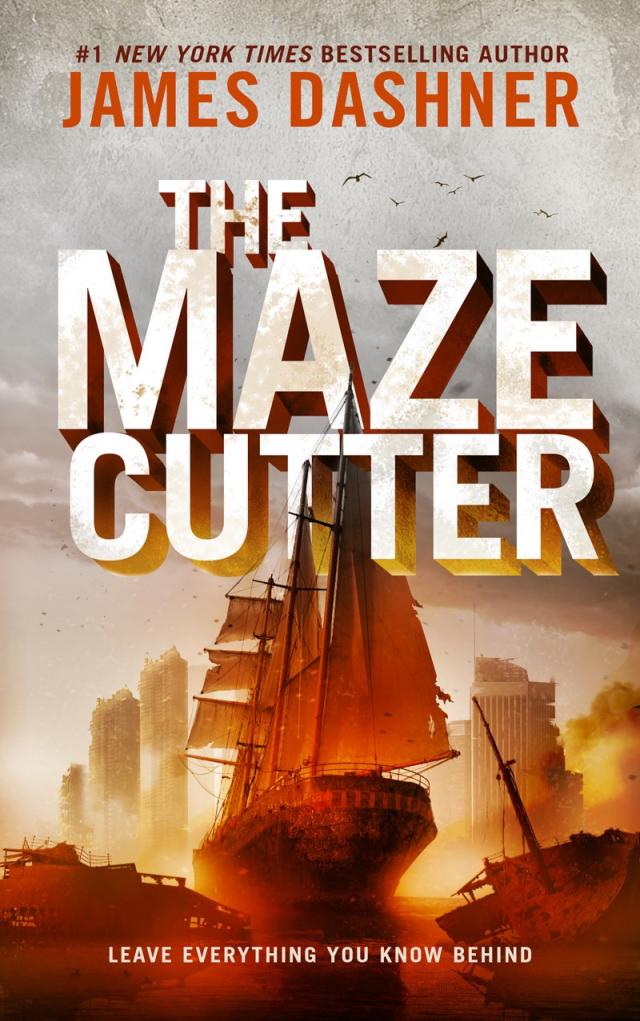
The maze cutter, p.1
The Maze Cutter, page 1


ALSO BY JAMES DASHNER
The Maze Runner Books
The Maze Runner
The Scorch Trials
The Death Cure
The Kill Order
The Fever Code
Crank Palace
The 13th Reality Books
The Journal of Curious Letters
The Hunt for Dark Infinity
The Blade of Shattered Hope
The Void of Mist and Thunder
The Mortality Doctrine Books
The Eye of Minds
The Rule of Thoughts
The Game of Lives
Adult Books
The House of Tongues
This is a work of fiction. Names, characters, places, and incidents either are the product of the author’s imagination or are used fictitiously. Any resemblance to actual persons, living or dead, events, or locals is entirely coincidental.
Copyright © 2022 by James Dashner
* * *
All rights reserved. Published in the United States by Akashic Media Enterprises, also doing business as AME Projects. Visit us on the web at AkashicMediaEnterprises.com. Printed in China by We Think Ink. Interior formatting by Hannah Linder Designs.
* * *
Publisher’s Cataloging-In-Publication Data
(Prepared by The Donohue Group, Inc.)
Names: Dashner, James, 1972- author.
Title: The maze cutter / James Dashner.
Description: First edition. | [Red Bank, New Jersey] : Akashic Media Enterprises, [2022] | Series: The Maze cutter ; [1] | Interest age level: 012-018. | Summary: "73 years after THE MAZE RUNNER series, the descendants of dystopia have thrived on the island but must leave everything they know behind when a ship comes from the old world with news about how they are needed to save civilization"-- Provided by publisher.
Identifiers: ISBN 9798985955200 (paperback) | ISBN 9798985955217 (ebook)
Subjects: LCSH: Islands--Juvenile fiction. | Survival--Juvenile fiction. | Dystopias--Juvenile fiction. | CYAC: Islands--Fiction. | Survival--Fiction. | Dystopias--Fiction. | LCGFT: Dystopian fiction. | Action and adventure fiction. | Science fiction. | Apocalyptic fiction. | BISAC: YOUNG ADULT FICTION / Dystopian. | YOUNG ADULT FICTION / Action & Adventure / Survival Stories. | YOUNG ADULT FICTION / Science Fiction / Apocalyptic & Post-Apocalyptic.
Classification: LCC PZ7.D2587 Ma 2022 (print) | LCC PZ&.D2587 (ebook) | DDC [Fic]--dc23
* * *
ISBN 979-8-9859552-1-7 (ebook)
* * *
First Edition
* * *
Akashic Media Enterprises supports the
First Amendment and celebrates the right to read.
This book is dedicated to Marisa Corvisiero.
Agent, friend, and life-saver.
CONTENTS
Prologue
Part I
Chapter 1
Chapter 2
Chapter 3
Chapter 4
Chapter 5
Part II
Chapter 6
Chapter 7
Chapter 8
Chapter 9
Part III
Chapter 10
Chapter 11
Chapter 12
Part IV
Chapter 13
Chapter 14
Chapter 15
Chapter 16
Epilogue
About the Author
EPIGRAPH
Even as the darkness whispers across my mind, beckoning with smoky tendrils of blackness and rot, even as I breathe in the stench of a dying world, even as the blood within my veins turns purple and hot, I feel the peace of a certain knowledge. I have had friends, and they have had me.
And that is the thing.
That is the only thing.
* * *
—The Book of Newt
PROLOGUE
Voices from the Dust
Thomas found the journal three weeks after the world ended. It still baffled him. How? When? When and how? When had his friend written all those pages and how had it gotten inside one of several boxes sent through the Flat Trans before Thomas and his friends made the trip themselves? Ava Paige had done it, of course, as she had done everything. But again. How? When? Those words occupied his mind like two guests refusing to leave, well after the party has wrapped.
He sat upon his favorite ledge on his favorite cliff, looking out at the vastness, the forever, the endless void of the ocean. The air was clean and fresh, bitten with the tang of fish and the sweetness of decomposing life. Small wisps of spray tickled his skin, cool against the heat of the sun directly overhead. He closed his eyes, blanking out the horizons that daunted him, made him feel as if he’d been stranded on the moon. Mars. Another galaxy. Heaven. Hell. What did it matter? He shifted on the jutting edge of rock to get more comfortable, his legs dangling over the roar and splash of depthless water, black-blue, as far away from the world as he could fathom.
Of course, that was a good thing. Right? Yes, it was. But escaping disease, madness, and death did nothing to replace the sadness at what had been lost. Which brought him back to the journal.
He opened his eyes and picked up the warped, tattered, muddied book from where he’d set it earlier, atop a single shelf of sandstone that appeared as if it had been sculpted by time’s chisel to house a sacred artifact. Sacred. Artifact. That sounded about right.
He opened the book in his lap, casually but with care, and flipped through its many pages, every last one of them filled top to bottom with the scrawling penmanship of a child. The slant of the words, the urgency of the ink—pressed and dark with increasingly thicker strokes—the size of the letters . . . Each passing page visually represented what the actual content revealed in heartbreaking starkness—his best friend descending into utter, complete, savage madness. The journal ended with about thirty empty pages. The last one to contain writing had only one word, its letters filling the entire space, scrawled with violence: PLEASE.
Man, Newt, Thomas thought. Wasn’t it bad enough? Wasn’t the end the peak of our awfulness? Why in the hell did you have to let this book exist, let it get into the hands of Ava Paige? Why?
But even as those harsh considerations stomped across his mind, Thomas knew they were empty of meaning. He loved this journal. This book. These words of his friend’s. Any pain they brought back only served to frame the bigger picture—the canvas upon which a piece of Newt’s life had been painted, for them to have forever. For their kids to have. For posterity. A museum piece of memories, the good and the bad.
Thomas thumbed through the pages of the journal and chose one at random, though he cheated and erred toward the front, when Newt’s symptoms had only begun to blossom. No one knew exactly when he’d started writing because there were no dates and not a lot of references to specific events. But the passage that Thomas read now had to be the day they’d left their friend behind, in the Berg, while they stole their way into the city of Denver.
Thomas breathed in each word, savored it, pondered it:
I feel like a dick saying this, but I gotta get out of here. Can’t take it anymore. I love these people. I love them more than I could’ve possibly ever loved anyone. And I obviously say that because I can’t remember my mum and dad. But I imagine it would be like this. Family. That’s what they are. Thomas. Minho. Everyone. But I can’t be with them one more day. It’s killing me, and that ain’t some bloody joke. I’m done. For them, I’m done. Gone. And that ain’t a joke, either. I guess these words just come naturally. Killing. Gone. Gotta put this diary down, now. I have another note to write.
Thomas closed the book and placed it back on the shelf above his head. Then he lay down on his side, legs curled up to his body, head on forearm. And he stared at the wet fields of ocean that stretched to every limit of thought and sight. Beneath that rough, wavy, sketched-icing surface, he knew that billions of creatures lived, oblivious to things like Cranks and deserts and mazes. They swam and they ate, their world probably hurt by the sun flares that had ravaged the lands above, but just as likely healing all the faster. Someday, surely, the order of things in the natural world would do just fine.
But what about us? he thought. What about the humans?
And then, despite his eyes being wide open, staring at the fathomless reach of the ocean, all he could see were images of people. Newt. Teresa. Alby. Chuck. So many lives, lost.
Man, you’re depressing, he chided himself. Somehow—for today, at least—he had to stop thinking about all this crap. He got up, grabbed Newt’s journal, and headed down the path that wound its way along the cliff and through the sandy grasses, finally leading to the new Glade. It wasn’t much as of yet, but someday it might be. Give the humans a chance, right?
“Hey!” someone shouted from up ahead. Frypan. “I figured out a new way to cook these damn fish!”
Thomas could already smell it.
PART ONE
73 Years Later
It’s a funny thing, losing what you love. When able, I think often about loss. If I could go back in time, to my earliest youth, and some godly, magical being had shown me the future and given me a choice, what would I have chosen? If this god had revealed to me the two major losses of my life, and allowed me to prevent only one, which would I have selected?
Newt, this heavenly creature might have said. Your mind, or your friends?
I now know my answer:
What’s the difference?
—The Book of Newt
CHAPTER ONE
Trinity o f Terror
In a place called Alaska, Alexandra Romanov stood on the balcony of her home and gazed upon the city, shrouded in darkness, sprinkled with the bright yellow winks of gas flames in windows and on street corners. Not a cloud blotted the stars in the sky, which shone down with perfect clarity, each one an almost perfect spear tip of light. The clean air hugged her like invisible fog, warm and moist, dampening her hair, her clothes, her skin. She breathed in, deeply, relishing this bird’s-eye view of the quiet world below.
Her world. Alaska. There were others out there, other . . . worlds. The Remnant Nation, somewhere in the plains of Nebraska. There were the mad doctors down in California, doing things no sane people should. But they were far as things go and went. Alaska was hers.
Never mind that she shared it with two others. Nicholas. Mikhail. Nicholas and Mikhail. But she felt the ownership, felt the power, as if it were all her own. And someday, perhaps, it would be. Until that day, she’d refine her enhancements of the Evolution, perhaps sabotage the others bit by bit, while still letting the weight of their terrible purpose rest on them from time to time. Fight terror with terror. End tragedy with tragedy.
Didn’t they say that all tragic things occurred in groups of three? Deaths, earthquakes, tornadoes. She’d only known one set of triplets in her life, but those kids had been hell on tiny feet, their piercing cries during the night of the Evolution still a memory that rattled her. She had not been the one to put an abrupt end to those cries, but it would be the greatest of untruths to say she hadn’t been minutes away from finishing them off, herself. And, oh, what immense relief she breathed in at the sweet silence that followed.
Bad things come in threes. That was a philosophy as old as time. And they were three, the Godhead—Evolved; thoughts faster than a lifetime of words spoken at once; machine-like control of the senses, the physiology, the chemicals, the endorphins, all of it; the mental capacity of a universe to suck in all light and knowledge. They had Evolved, of that there could be no doubt. But she—yes, she—was beyond them, beyond the both of them combined. This, Alexandra knew. But for now, they were three.
Her mind flashed, memories upon memories, all in an instant. The Flare and its many variants, building minds to fix the unfixable. Maybe it had all served a purpose, millennia of terrifying trinities, preparing the human race for what had arisen, what had come into being to eradicate terror itself, by any means necessary.
The Godhead.
Hell, it worked for her.
“Goddess Romanov?”
Dammit. She’d hoped for more time, more time-wasting. She turned away from the beauties of her city and faced the man who’d spoken her name. A tall, gangly fellow, he always reminded her of a walking tree branch, the fact that his joints didn’t crack and pop and splinter with every step a small shock to her subconscious.
“What’s going on, Flint?” The man’s name wasn’t Flint, but she called him that for the sole reason that she wanted to. He seemed . . . lessened by it, and that was okay. Ideal, even.
“There’s a kink in the rotation of pilgrims.” His voice was like the spill of raw ore from a wheelbarrow. “I have the exact numbers here, but by morning we’ll be off by at least eight percent in every part of the city. Everything will be thrown off.”
Alexandra studied him, used the training she’d received in the Flaring discipline. Every tick of his muscles, every shift of his eyes, every movement, no matter how subtle, fed into the hyper-function of her thought processes. He was avoiding what he really came here to say.
“Spit it out, Flint. What the hell happened?”
He drooped a slow blink, let out a sigh of resignation, realizing how futile it was to hide his emotions behind what was—to her—a see-through mask. “Seven pilgrims were killed at the dye pools. It was done with . . . violence.”
“Violence?”
“Immense violence.” He’d been slowly raising his clipboard and charts, readying to share data. But now he dropped it to his side. “Four men. Two women. One child. A boy. They were—”
“Hollowed,” she said. “They were hollowed, weren’t they?”
His face had paled a bit. “Yes, Goddess. Done quite professionally, I might add. Cleaned out. The, uh, refuse was nowhere to be found. Only the ribs remained.”
“Damn that man,” she whispered, fury threatening to overcome her Flare sensibilities. She counted through the digits, that precise mathematical sequence she’d learned as an acolyte that brought peace, calmness, the brain having no choice but to release the appropriate chemicals. “Do you know where he is?”
Flint knew exactly who she was talking about—she read his eyes as easily as the charts and tables he carried with him at all times. As evident as sunlight, she knew he envisioned those poor victims in the dye pools, how they’d been sliced from aft to stern, their every essence of life removed with violent but precise efficiency. The blood, the stench, the horror of such a thing . . . only a certain type could do it and remain hinged. And the both of them standing there had already arrived at the correct conclusion.
“Uh, I believe that he’s gone to the . . .” Flint cleared his throat, clearly uncomfortable sharing such personal information from one member of the Godhead to another.
Alexandra stepped close to him, controlled herself until she stood rigid as a corpse. Then she locked her eyes with his, utilizing the optic hypnosis techniques of her discipline. “Tell me where he is.” The proper inflection in her voice sealed the deal.
Flint nodded in submission, then spoke, almost trance-like.
“Mikhail has gone to the Glade.”
Alexandra tried to suppress her shock, but for the first time in an age, her training in the ways of the Flare completely abandoned her. A blinding flash of anger exploded within her mind, erasing the world around her for the briefest of moments. Why? Why did Mikhail do this now? She wanted to scream but snatched it back—literally snapping an arm out as if her voice were a physical thing. Her rage subsided; her vision returned. Flint had a red gash across his cheek, the skin sliced by her very own fingers, her painted nails. A petulant act; she needed better control.
She looked at the poor man, those eyes soaked with fear. “Bandage that, quickly. If Mikhail’s in the Glade, we need to hurry.”
Clank.
Clank.
Clank.
Isaac had been dreaming that sound for quite a while, now. Constant, incessant, annoying-as-hell CLANKs that found all kinds of ways to audibly haunt his nightmares. First it was a bird, a black, furry-looking thing, perched atop the wooden fence that surrounded Old Man Frypan’s acre on the northern side of the island. The creature’s sharp beak hinged open and closed, open and closed, letting out that CLANK of a noise each time, like the bark of a mechanical dog.
Then it segued into a giant machine, a thing Isaac had been told about in the campfire stories of the old world, a thing he imagined now, as inaccurate as it may be. It was called a bulldozer, and for some inexplicable reason it was fruitlessly trying to plow over a mountain of metal trees, glistening silver and immovable. Clank, clank, clank it went, as the bulldozer rammed its way forward relentlessly, its giant scoop dinged and dented.
Then there was a man, standing in front of him, nothing but a dark sky as the backdrop, full of stars. The man had no hair and no eyes. He had half a nose. He had one ear. And although it was hard to tell for sure in the bare light, the man’s skin glistened in rivulets that had to be blood, seeping from a dozen wounds. That is one ugly son of a bitch, Isaac thought.






