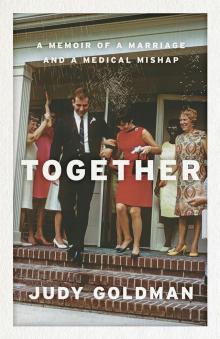
Together, p.1
Together, page 1


Also by Judy Goldman
NONFICTION
Losing My Sister
FICTION
Early Leaving
The Slow Way Back
POETRY
Wanting to Know the End
Holding Back Winter
Copyright © 2019 by Judy Goldman
All rights reserved. Published in the United States by Nan A. Talese/Doubleday, a division of Penguin Random House LLC, New York, and distributed in Canada by Random House of Canada, a division of Penguin Random House Canada Limited, Toronto.
www.nanatalese.com
DOUBLEDAY is a registered trademark of Penguin Random House LLC. Nan A. Talese and the colophon are trademarks of Penguin Random House LLC.
Portions of this work originally appeared in the following publications: “Holding Back Winter” in Holding Back Winter (St. Andrews Press, 1987); “Love in North Carolina” in Best Creative Nonfiction of the South (Texas Review Press, 2017); and “Finger on the Trigger” in drafthorse (Winter 2016).
Cover design by Michael J. Windsor
Cover photograph courtesy of the author
Library of Congress Cataloging-in-Publication Data
Names: Goldman, Judy (Poet) author.
Title: Together : a memoir of a marraige and a medical mishap / by Judy Goldman
Description: First edition. | New York : Nan A. Talese /Doubleday, 2019.
Identifiers: LCCN 2017060152 | ISBN 9780385543941 (hardcover) | ISBN 9780385543958 (ebook)
Subjects: LCSH: Goldman, Judy (Poet)—Marriage. | Authors, American—20th century—Biography. | Woman authors—20th century—Biography. | Medical errors—United States.
Classification: LCC PS3557.O3688 Z46 2019 | DDC 811/.54 [B]—dc23 LC record available at https://lccn.loc.gov/2017060152
Ebook ISBN 9780385543958
v5.4
ep
Contents
Cover
Also by Judy Goldman
Title Page
Copyright
Dedication
Epigraph
Chapter 1
Chapter 2
Chapter 3
Chapter 4
Chapter 5
Chapter 6
Chapter 7
Chapter 8
Chapter 9
Chapter 10
Chapter 11
Chapter 12
Chapter 13
Chapter 14
Chapter 15
Chapter 16
Chapter 17
Chapter 18
Chapter 19
Chapter 20
Chapter 21
Chapter 22
Chapter 23
Chapter 24
Chapter 25
Chapter 26
Chapter 27
Chapter 28
Chapter 29
Chapter 30
Chapter 31
Chapter 32
Chapter 33
Chapter 34
Chapter 35
Chapter 36
Chapter 37
Chapter 38
Chapter 39
Chapter 40
Chapter 41
Chapter 42
Chapter 43
Chapter 44
Chapter 45
Chapter 46
Chapter 47
Chapter 48
Chapter 49
Chapter 50
Chapter 51
Chapter 52
Chapter 53
Chapter 54
Chapter 55
Chapter 56
Chapter 57
Chapter 58
Chapter 59
Chapter 60
Chapter 61
Chapter 62
Chapter 63
Chapter 64
Chapter 65
Chapter 66
Chapter 67
Chapter 68
Chapter 69
Chapter 70
Chapter 71
Chapter 72
Chapter 73
Chapter 74
Acknowledgments
A Note About the Author
For Henry
Once and for all, let me say it here:
I am the lucky one.
For one human being to love another human being: that is perhaps the most difficult task that has been entrusted to us, the ultimate task, the final test and proof, the work for which all other work is merely preparation. That is why young people, who are beginners in everything, are not yet capable of love: it is something they must learn. With their whole being, with all their forces gathered around their solitary, anxious, upward-beating hearts, they must learn to love.
—Rainer Maria Rilke, in a letter to the nineteen-year-old Franz Xaver Kappus
The secret of a happy marriage remains a secret.
—Henny Youngman
1
Henry and I are at the kitchen table, eating breakfast. Grape-Nuts, sliced banana, milk for him. Oatmeal for me, with walnuts chopped small, fresh blueberries, and dried cranberries. Mugs of coffee. I did not always drink coffee. My feeling was that it never tasted as good as it smelled. But with enough half and half, I like it now. Funny about how we describe ourselves. One minute, we’re: Oh, I’m not a coffee drinker. Never touch it. The next, we’re solidly in another camp: Have to have coffee every morning. Who we are can flip like that. The details always shifting. Henry picks up the Sports section, folds it in half, then half again, pushes the rest of The Charlotte Observer to the far side of the table. I’ve got the Living section. It’s mid-February 2006. Outside: wintry and windy. And wet.
“Doesn’t this sound like a good idea?” he says, pointing to an ad I can’t read from where I’m sitting. “A nonsurgical procedure for back pain. Done by a physiatrist.”
“What’s a physiatrist?” I ask, scooting my chair closer so that I can read even the fine print.
“According to the ad, physiatrists are MDs,” he says. “Apparently, they treat spinal problems.”
Six years ago, Henry had surgery for spinal stenosis, which helped some. But his back has never really stopped hurting. He’s stiff when he gets out of bed in the morning. Can’t stand for long, finds a chair pretty quickly wherever he happens to be. He lives a normal life, though. A normal life with backaches. He’s so athletic, what he’d really like is to be able to jog again, play racquetball, tennis.
Yes, I say, that does sound like a good idea.
* * *
.
The physiatrist tells Henry he believes he can help. From what I can understand, he’ll use fluoroscopy for guidance while he injects steroids and an anesthetic into the epidural space—between the spine and the spinal cord. The procedure will take about thirty minutes, followed by maybe forty-five minutes of recovery time. Henry will be monitored for an additional fifteen to twenty minutes, then discharged to go home. An hour and a half—total! Compare this to hours on an operating table, days in the hospital, the long recuperation that back surgery entails. This injection is so common, it’s given to women during childbirth. The physiatrist explains that an epidural steroid injection can be highly effective because it delivers pain relief directly to the source of the problem. He recommends two injections, spaced three weeks apart; he needs to inject two different areas. As with all invasive procedures, there are risks. Generally, though, the risks are few and tend to be rare: headache, infection, bleeding, nerve damage.
Henry signs the consent form.
* * *
.
A week later, we report to the hospital outpatient clinic for the first epidural. Afterward, Henry’s right leg is numb. Very little feeling. The physiatrist, a tall fellow with a friendly face and thick, hay-colored hair anyone would envy, says something like “The numbness is a great sign! It means the epidural is working!”
Henry’s leg is so numb he can barely walk. He leans on me as I help him from the car into our house and to our bed. He goes right to sleep, which is unusual for him. I don’t think I’ve ever seen him take a nap. The little bit of walking he did completely exhausted him. I keep checking the handout: If numbness persists longer than eight hours, call the office. Every hour, I wake Henry to ask about the numbness. Every hour, he says his leg is still numb. Then he drifts back off. I don’t relax my shoulders for a minute. The eighth hour, I have my hand on the phone, ready to dial. I ask him one last time. All feeling has returned. No need to call. My shoulders relax.
His second epidural is scheduled for three weeks from now.
* * *
.
But first our vacation, planned months ago, on the French side of the island of St. Martin. The romance of spending long days in two chaises pulled close, our bare toes touching, how warm we are from the sun, lost in our books. Less than a hundred feet away, our lunch place juts out over the sea, the smoky grill, the smell of fresh-caught fish coo king.
Evenings, we stroll the rutted mile from our small resort to the row of Caribbean-colored, gingerbread-cottage restaurants. Henry’s back is still hurting, so we have to stop every now and then for him to stretch—backward, forward, bending way over, hands on knees—but a little pain is not going to keep him from what he wants to do. The moon’s soft light catches the sea grape leaves all around us. We debate the menus posted on the little front porches. Our main concern: Are we in the mood for mussels or sole?
* * *
.
Seven days after St. Martin, we leave early for our one-forty-five appointment at the same hospital outpatient clinic as before. It’s one of those golden North Carolina days that always make me wonder why anyone would ever want to live anywhere else. Pure sunlight, air fragrant.
Henry checks in. There are so many people here, the waiting room feels tight. The only available chairs together are catty-corner, a square table in between. But no sooner do we sit down than a nurse comes to take Henry back. She has an air of efficiency about her—the way she holds her head and her shoulders, her sensible nurse shoes. I didn’t know anybody still wore those. She says she’ll call for me in a few minutes, after they get him ready; I can keep him company while he waits for the doctor. I pick up People magazine and settle in, even though I don’t recognize the names of any of the celebrities.
I glance at my watch. How did it get to be three o’clock? Why aren’t they coming for me?
At three-thirty, a nurse—not the same one who took him back, but a shiny-faced young woman, perky, smiley—appears and says that my husband has had the epidural.
“Oh,” I say, “I thought somebody was going to come get me so I could be with him before—”
“Well,” she says, “we’re real busy today, and things got sorta hectic back there, and then the doctor was all of a sudden ready for him around three o’clock, and we never had a chance to come get you.”
I walk behind her down the long hall. She’s repeating, brightly, “Your husband’s verrry numb! Verrry numb!” as though she’s marveling over some unusual turn of events, more amusing, really, than anything to worry about.
“He’s numb?” I ask, trying to match her brightness, wondering why my little laugh is coming out shaky.
She stops outside a closed door. Pauses. Opens it. I follow her in.
When she moves to the side and Henry is in full view, I see that he’s flat on his back on a gurney, a sheet pulled up around his neck, the way you’d tuck in a child. His expression is contorted. His whole face an agonized flinch. As though he took the world head-on and lost.
“Judy,” he whispers, his eyes clutching at mine, “I can’t feel a thing from my waist down. I can’t move my legs.”
I turn to the nurse. “Where’s the doctor?” My voice rises with each word, going someplace totally unfamiliar. “Does the doctor know?”
“Well,” she says, “not exactly.”
“He needs to see this!” My voice verges on shrill. My hand brushes the air. “Go. Get the doctor. Please! Ask him to come in here!”
She’s backing out of the room.
I’m shivering.
* * *
.
I sit down beside Henry, put my hand on his arm. I don’t know where to touch him, if it’s even okay to touch him.
“Tell me,” I say.
He says that when the doctor was giving the injection, he felt severe pain. He must have groaned, because the doctor asked him, Are you okay? He told the doctor, No, I’m not okay. I’m in excruciating pain. The doctor said, We’re almost done. Then he finished the injection.
Henry tells me that his back, where the needle went in, still hurts.
* * *
.
Maybe it’s not as bad as I’m terrified that it is. Maybe he’s really all right. Maybe I can help him be all right. Maybe what’s been taken away can be brought back. I just have to figure this out. But I need to hurry. Before it—whatever it is—locks into place.
I loosen the sheet around his feet.
“Can you feel this?” I scratch his bare toes.
“No,” he says. “Not at all.” He sounds as though he’s grown tired somewhere deep in his body.
“Can you wiggle your toes?”
“I’m trying. Are they moving?”
They aren’t. I wiggle them myself, to get them started. But then, nothing.
“Can you flex this foot? Or this one?”
“I can’t make either one move.”
“How about your leg?” I tap his knee through the sheet. “Can you lift your leg? Can you lift it just a little? This one? Or this one?”
“I’m trying, I’m trying as hard as I can.”
I stroke the tops of his feet, then the soles, with my fingers. For a second, I think how another time, another place, I might run my hand down his calf to his foot. Maybe in the morning, on my way to the bathroom, rounding the bed, I might reach under the sheet and touch the bottom of his foot. That careless, offhanded thing married people do.
“What about this?” I ask, massaging his ankles. “Can you feel me doing this?”
“I can’t.”
Now I’m reaching under the sheet and rubbing his calves.
No.
I reach farther and touch his knees, thighs, groin, buttocks.
No, no, no, no.
He feels nothing.
I feel everything.
* * *
.
One minute you’re complaining that the zinc-based sunscreen you’re supposed to wear in the Caribbean goes on like Elmer’s Glue. The next, you’re Googling paralysis. Everything is okay. Then nothing is. That thin line. How a brushfire can erupt on a perfectly sunny, clear-skied day. How your life can be taken right out of your hands.
2
Barrel-chested, bruiser Henry—I always loved that he was so big and strong and brave. Sensitive and kindhearted, yes (my friends say he’s the most “evolved” of all our husbands, the one most likely to join a cluster of women talking, the one most likely to get up at night with a fussy baby), but if you met him, your first impression would be sturdiness. Sturdy is what I must have been after when I married him. Not consciously, of course. But it was probably on my checklist.
As a child, I was slight, not athletic, not known for physical strength, not brave. My grandpa called me Flimely, a Yiddish word meaning little bird. That image of me stuck. I was sweet. Demure. Too small to be taken seriously. Or, at least, that’s how I saw myself. Everyone else saw me that way, too. My sister, Brenda, three years older, was the strong one. It’s how she defined herself. The rest of us believed deeply in that definition, too. I can’t remember a time when she wasn’t big. (Was she born five-eight?)
My mother rewarded me for being me with all the attention in the world. Maybe because I’d nearly died when I was born. Maybe because I was the baby of the family, youngest of three, an accident she forever after expressed gratitude for. (“What would we do without our Judy?”)