Their together promise, p.1
Their Together Promise, page 1
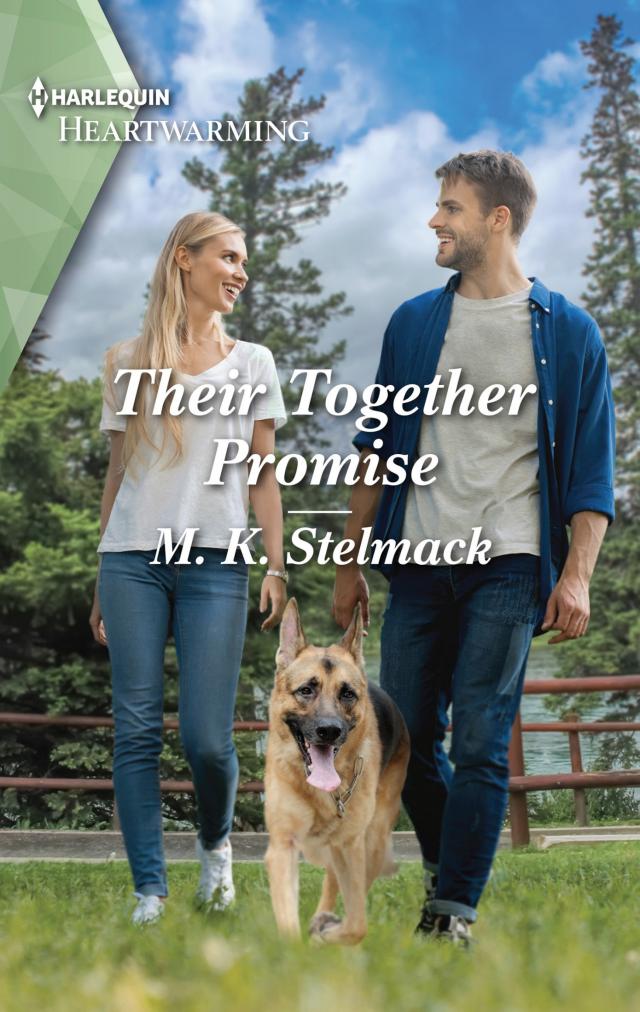


“I’m not in the market for a dog.”
“I’m not trying to sell you anything. Honestly, Mara. Yes, my guide dog is about to finish her training and I am looking to place her. Yes, I think she’d be perfect for you, but she’d be perfect for some other person, too. Is there any way we can make this thing work?”
She moved her hand to the door latch. “I don’t think so. Griffin only tolerates me when you’re around.”
“How about I come along?”
Her blue eyes widened. “I didn’t mean—that is, I didn’t mean to involve you.”
“Listen, you’re doing me the favor. Hopefully it’ll just be for a few times until he gets used to the situation.”
He held his breath. And why was he doing that? He wasn’t asking her out on a date. Except they’d be alone together, doing something that would look very much like a date. And he liked that...
Dear Reader,
This story couldn’t have happened without help. I relied on the experiences and wisdom of those in the visually impaired community to inform Mara’s struggles and victories. My thanks to Derek Ness with the Canadian Institute for the Blind, who spoke to the societal challenges. Special thanks to Victoria Nolan. A powerhouse in her own right, she has retinitis pigmentosa, RP, like Mara, is the mother of two children and has a guide dog. She was a storehouse of emotional and practical knowledge. I also turned to vlogger Molly Burke. Her candid documentaries lent insight into the unique relationship between a guide dog and the handler. It is because of her that Mara too sees “fireworks.” Any errors are mine alone.
This completes The Montgomerys of Spirit Lake miniseries. See what’s coming at mkstelmack.com. You can also find me on Goodreads, Facebook and Instagram.
Best!
M. K.
Their Together Promise
M. K. Stelmack
M. K. Stelmack writes historical and contemporary fiction. She is the author of A True North Hero series—the third book of which was made into a movie—and The Montgomerys of Spirit Lake series with Harlequin Heartwarming. She lives in Alberta, Canada, close to a town the fictional Spirit Lake of her stories is patterned after.
Books by M. K. Stelmack
Harlequin Heartwarming
A True North Hero
A Roof Over Their Heads
Building a Family
Coming Home to You
The Montgomerys of Spirit Lake
All They Want for Christmas
Her Rodeo Rancher
Visit the Author Profile page at Harlequin.com for more titles.
To those who struggle with disabilities—and, every single day, triumph
Contents
CHAPTER ONE
CHAPTER TWO
CHAPTER THREE
CHAPTER FOUR
CHAPTER FIVE
CHAPTER SIX
CHAPTER SEVEN
CHAPTER EIGHT
CHAPTER NINE
CHAPTER TEN
CHAPTER ELEVEN
CHAPTER TWELVE
CHAPTER THIRTEEN
CHAPTER FOURTEEN
CHAPTER FIFTEEN
CHAPTER SIXTEEN
CHAPTER SEVENTEEN
CHAPTER EIGHTEEN
EPILOGUE
EXCERPT FROM THE COWBOY’S UNLIKELY MATCH BY LISA CHILDS
CHAPTER ONE
MARA MONTGOMERY FEIGNED interest as her two sisters stood like performers in front of the fireplace directly across from Mara on the sofa. She hadn’t the heart to tell Bridget and Krista that at ten feet away they were still blurry, their matching gray sweatshirts melding them into a cloud. If they were indeed gray, and not brown or blue or orange or whatever other color that her brain now registered as that dull, dull hue.
At the periphery of her vision sat their respective husbands, Jack and Will, on either side of their wives. Sometimes she couldn’t tell the difference between them and had to wait for their voices or a little cue. Will, whether he knew it or not, always cleared his throat before speaking to her. Jack opened with a gesture.
Beside Mara, her mother gusted out her breath. “Just get on with it, will you?” She sounded impatient and bored. Did she know what her daughters were about to announce, too?
The seat cushions dipped and jiggled as Bridget and Jack’s daughters, Sofia and Isabella, bounced into the room in their pajamas, their hair perfumed strawberry and vanilla. Mara protected her full wineglass with her hand.
Krista-cloud said to Bridget-cloud, “Are you ready?”
They stripped off their sweatshirts to reveal white shirts with dark lettering and pictures. Mara couldn’t make out the words, but her mother read them.
“Bridget’s says ‘Cinna-bun in the oven.’ And Krista’s says ‘Farm help on the way.’”
Just as she thought. In the lead-up to tonight’s dinner at Bridget and Jack’s house, both Bridget and Krista had laid on the hints. I’m so tired! So weird, I crave pickled onions! I’ve decided to give up alcohol. Their mother must’ve gotten the same treatment because her surprise sounded forced. “Oh, who would’ve thought? Congratulations, girls.”
The shirt messages were too subtle for Isabella and Sofia. “What? What!” They tugged on Mara’s sleeve. She slid her glass onto the relative safety of the coffee table. She would need every drop to get through this happy ordeal. “Bridgie-ma and Jack-pa are having a baby,” she said. These were the names the girls had chosen for their parents since their adoption last year. “Auntie Krista and Uncle Will, too.”
Sofia squealed and hugged Bridget. She cupped her mouth and shouted at Bridget’s belly. “Hola! Can you hear me? This is your sister, Sofia. I am six and I will share my things with you.” She turned to Isabella. “Your turn. Say something.” Instead, her nine-year-old sister kissed the cinnamon bun on Bridget’s shirt.
“Congratulations.” Mara forced herself to smile. Her facial muscles quivered. She never knew a smile could hurt so much. “When?”
“November!” They said simultaneously. Seven months from now.
“Our due dates are two weeks apart,” Bridget said. “Mine is—”
“—on the second and mine is on the sixteenth which means we could have them on the same day.”
Her mother rose and wrapped her pregnant daughters in a hug. Wearing a shawl, she was a great gray cloud enveloping white cloud puffs. “I could be a twin grandma.” Her grumpiness had given way to teary excitement. Their mother was family-renowned for her emotional swings. Mara, for her lack of them.
“And me a twin auntie,” Mara said, trying to make it sound as if it was all she ever wanted. She lifted the wine to her lips, smelled the faint nutty, sun-and-leaf aromas, let the stream flood her tongue, sluicing over her taste buds and trailing, warm and healing, down her throat. That was the thing with wine—you didn’t have to be sighted to understand it.
In the middle of distributing her gift of “Big Cousin” shirts to Isabella and Sofia, Krista gasped and spun to Will. “Speaking of twins—you want to tell or me?”
Will waved her on, and Krista bounced as bad as her nieces. “Keith and Dana are expecting twins! In September. I’m going to be a twin auntie, too!”
“Triple,” Will said. “Don’t forget Laura.”
“Right, she’s up first in May. A month away! Weeks! Days, if she hurries up.”
Will folded his hands across his stomach. “Claverleys littering the place.” He spoke as if he’d pulled off the feat single-handedly.
“And there’s a shirt for it!” Krista reached into her bag. “‘Double Auntie’ T-shirt.” Soft cotton brushed Mara’s empty hand and she took the shirt. In yellow letters the size of a traffic sign, Mara read “Double Auntie premiering November.” “I ordered the same one in red for myself,” Krista said.
Mara tucked the shirt by her side. “Thank you,” she managed to choke out. “I think it’s time I topped up my wine.”
Once in the kitchen, Mara brushed her hand along the wall and found the light switch. A jumble of shapes. Pots and pans and dirty platters, points of light radiating away. Jack and Bridget insisted that no one help with cleanup because they liked to do it together as their nightly wind-down routine. Sweet, except that the clutter was a potential trap for Mara.
She had no intention of drinking more. Two glasses was her cutoff, especially since her volunteering started in less than an hour at the youth center, but to keep up appearances, she navigated the corners and counters toward the wine rack, depending on her muscle memory from when she’d lived in the house for a few months. That had been more than a year ago. How things had changed. Both sisters now married and pregnant, with good husbands. As for her, no husband, not even a boyfriend, certainly not pregnant. Her world had grown darker and narrower like the aperture on an unfocused telescope.
She leaned against the counter beside the wine rack, the one spot that couldn’t be seen from the living room. She’d pull herself together before reentering the fray.
“If you’re not having one, I will,” her mother said, coming into the kitchen.
Mara tipped the bottle over her mother’s empty glass and listened to the glug of the wine, lifting it up in time. She tilted her head to the chatter in the living room. “Did you know?”
“I suspected,” Deidre said. “I thought you were in on the secret, too.”
“No,” Mara said. “I wasn’t.” She usually was privy to her sisters’ secrets. Krista’s, especially. But motherhood had changed all that. The oldest and youngest sister formed their own little club of two now. They’d exchange their experiences and stories. Tips about teething and diaper rashes and nursing and sleep schedules. Nothing for her to add. And probably after these babies were born, there’d be more. She’d be an auntie again. Always an auntie, never a mother.
Her own mother leaned close, her shoulder touching Mara’s. “This is hard, isn’t it?”
No, it wasn’t hard. Hard was learning when you were thirteen that you had degenerative vision loss, hard was watching (notice the pun, ha ha) her vision deteriorate year after year, the world closing into a narrow tunnel and then that tunnel losing its contrasts, its depth and brilliance. Even as sounds and smells and textures sprang up to make up for her crumbling vision, like wild plants over an abandoned house.
That was hard. But hard was still doable. She had graduated with her master’s and, during the past year, moved from British Columbia to Alberta and built her business as a psychologist. She couldn’t drive but she could get around the smallish town of Spirit Lake easily enough, especially in daylight hours. She could have groceries—and wine—delivered. All manner of listening and decoding devices smoothed out obstacles.
Family birth announcements were...fine. If she could process them in her own time and place. If she could curl up on her living room sofa or meditate or play Solitaire Chess.
Or watch her fireworks. Shortly after her father’s unexpected death from a stroke six years ago, her vision had worsened. Lights—blue, purple and green—appeared constantly. They spiraled, exploded, rained down...exactly like fireworks. Her specialist had said it wasn’t unusual, that she might as well enjoy the show. Their constant activity had distracted and annoyed her at first, but they’d become their own kind of mandala, a focal point when grief threatened to immobilize her. A place of beauty to travel to at any time and from where she could return calm and detached.
She could do none of that yet. But she could go for a walk. “I’m delighted that our little family is growing. Unfortunately, I’ve got to be on my way. The youth group is tonight.”
“You’re going to that?”
“I go every Wednesday.” She loved the kids. She soaked up their energy, their plans for the future, their playing at adulthood. She could live through them.
And because Connor Flanagan would be there. The other group leader. The guy that made her heart beat as if she were a lovestruck teenager. A stupid, futile crush she couldn’t stop, no more than she could stop her blindness.
“Let me drive you.”
“Mom, that’s your third glass of wine. No.”
“Let someone else take you, then.”
She most certainly did not want to be confined for any amount of time with either of her sisters or brothers-in-law, pretending to be over the moon. “I prefer to walk. The exercise will do me good.”
“Why do you need exercise? You’re skinny. And soon enough, you’ll be skinnier than all us Montgomerys for a good long while.”
Meaning no chance Mara would get pregnant, not being in a relationship. She’d never told her family that relationship or not, she’d never have children. It seemed irrelevant, obvious. Like announcing that rain was wet. But it grated that her own mother assigned her the role of family spinster, because mothers tend to reflect societal perceptions.
To hide her annoyance, Mara corked her bottle and edged into the living room to say her goodbyes. “But it’s getting dark,” her mother called after her.
Of all the things to say on this day. “It’s been getting dark for most of my life!”
Voices died away. She could feel the heat of her family’s gazes concentrate on her. Lovely. She’d ruined her sisters’ joy. She could think of nothing to say or do to repair the damage. Except to leave.
She held aloft the bottle. “Since you two won’t need this,” she said to her sisters. “I’m off.” The room remained quiet.
Her coat. Where was it? “Isabella, can you get my jacket, please?”
Jack stood. “I’ll give you a ride.”
Would they all just stop? “I’ve got the youth group tonight. I’ll walk.”
“You sure?”
“Yes. I’m sure.” Isabella pressed Mara’s sheepskin-lined coat into her hands. “Thank you. Congratulations, everyone.”
She fumbled with her coat. Something was stuck in the left sleeve. The double-auntie shirt. “I put it there,” Isabella whispered, “so you wouldn’t lose it.”
Protective, thoughtful Isabella. Mara felt a shot of resentment toward the niece who every other day she adored. She shoved the detestable shirt and the bottle into her bag and hustled for the door, not trusting herself to say something that wasn’t petty or self-pitying.
Outside in the cool air of late April, she snapped together her extendable white cane. Tap, tap, tap to the top of the stairs. She bet every single one of her family was staring through the front windows. Let them look. At least they could.
* * *
IT WAS ANIMAL floor hockey. The dozen or so kids were divided into two teams, Bears versus Penguins. Half were on all fours, trying to use a stick with their front foreleg, while the birds waddled about with bands around their ankles to restrict their motions. All wore helmets with face guards at Mara’s strict insistence.
Judging from the shouts and raps of sticks and squeaks from runners on the gym floor, along with the occasional play-by-play called out by the kids, Mara had scored big with this activity. The teenagers could cut loose for the evening, released from the usual pressures at home, school and, for a few, work. They were misfits one way or another. They didn’t participate in Spirit Lake’s massive sports programs. They weren’t academic achievers. No musicians or inventors or artists here. She’d been the same when she was their age.
A figure broke from the fray and walked over to where Mara sat on the lowest bleacher. Talia Shirazi. One of the oldest at sixteen, she was usually in the thick of whatever was happening, sorting out conflicts, organizing, strategizing. She’d shown leadership, a true talent, but tonight she dropped to the bench beside Mara.
“Taking a break?” Mara said.
The metal seating shook as Talia gave a quick one-two stamp to dispense with her ankle band. “I’m not feeling well.”
“Where is it hurting?”
Talia gusted out a sharp breath. “Everywhere. And nowhere.”
“My mother calls that being ‘out of sorts.’ Would you like to go home?”
“Not really.”
Was everything okay with her parents? Mara had met them a few times—busy, professional types who doted on their only child. Perhaps too much. Mara suspected Talia was a regular here because she was free to squirt whipped cream, get mummy-wrapped in toilet paper, sing opera off-key. One night a week where she could be less than perfect.
Mara could relate. But no. At the doors to the youth center she’d promised herself not to surrender to any more self-indulgent thoughts or behaviors. She pressed her fingers to her temple and focused on Talia. “Any plans for spring break?”
“We’re going to Mexico.”
Mexico. That brought back memories of brightness and color. Mara had traveled there with her parents and Krista when she was a kid. Back when she could see almost as well as everyone else. When she’d run and not worried about crashing into things and people.
No. Stop with the boohoo, poor you. This was not her.
“That’ll be nice. Loads of sun and beach and water.”
“I guess. But it’s practically spring now. We have sun and beach and water here.”
Talia sounded cranky. Mara dived to the heart of the matter. “You’ll miss Dane.”
“I don’t know. I guess.” Yes, something was amiss between them. They’d been dating for nearly a year, their relationship growing steadily more serious. A breakup now wouldn’t be fixed with a good cry into a pillow.
Beside them, the double doors rattled, the metal handle snapped down. A ripple of energy passed through the kids. “It’s Dog Man!”