Over the moon, p.1
Over the Moon, page 1


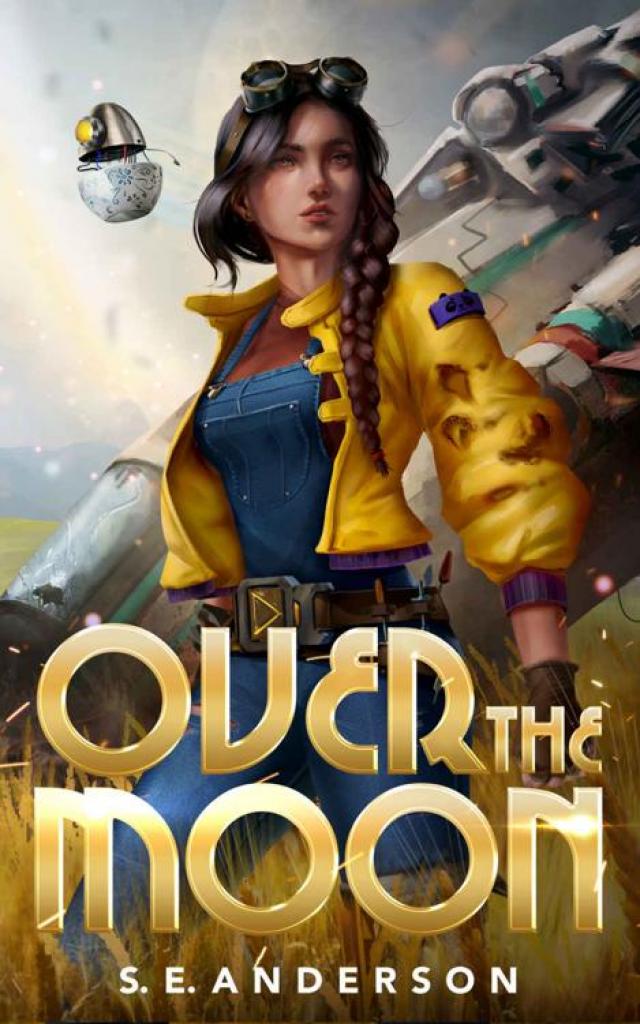
OVER THE MOON
S.E. ANDERSON
Contents
OVER THE MOON
I. Girl On The Moon
Before
Chapter 1
Chapter 2
Chapter 3
Chapter 4
Chapter 5
Chapter 6
II. Not On Nesworth Anymore
Chapter 7
Chapter 8
Chapter 9
Chapter 10
Chapter 11
Chapter 12
Chapter 13
Chapter 14
III. Stairway To Space
Chapter 15
Chapter 16
Chapter 17
Chapter 18
Chapter 19
IV. Man In The Moon
Chapter 20
Chapter 21
Chapter 22
Chapter 23
Chapter 24
OVER THE MOON
S.E. ANDERSON
Copyright © 2022 by Sarah E. Anderson
All rights reserved. No part of this publication may be reproduced, distributed, or transmitted in any form or by any means, including photocopying, recording, or other electronic or mechanical methods, without the prior written permission of the publisher, except in the case of brief quotations embodied in critical reviews and certain other noncommercial uses permitted by copyright law. For permission requests, write to the author, address: saraheanderson@protonmail.com
First Printing, 2022
Sea Breeze Books
ISBN:
978-1-7344495-3-2 (Ebook – EPUB)
978-1-7344495-4-9 (Paperback)
978-1-7344495-5-6 (Hardback)
Copyediting by Madeline Statham
Cover Design by Sarah Anderson
Cover Art by Petyr Donat
www.seandersonauthor.com
Created with Vellum
Part One
Girl On The Moon
Before
I’m seven years old the first time I see the girl who wears my face.
Princess Jo’Niss Sylvarian of the Sister Systems waves to the crowd from her father’s car, propped up by her mother as they drive down Mirah Memorial boulevard. I imitate the girl who has my skin, my hair, and I wave to the toys on the couch next to me, lined up to watch the coronation like the crowd on the screen. I wave out the windows, across the empty sea of corn. I wave like it’s me in that little blue car.
The princess is matching her mother, wearing a dress spun in the brightest yellow—a beautiful gold that shimmers when she moves. She looks so poised beside her parents, the newly crowned king and queen of the Systems; she is the first royal daughter since the Great Exodus that began her line. She doesn’t smile at the crowd, and instead keeps her lips a straight line, tight and dignified. It looks like she’s found a sweet candy and doesn’t want to seem too eager.
I try to do the same, but it feels like a frown, too hard and stiff. She must have practiced that look for hours.
“Oh honey, no, no, no!” Auntie rushes in, grabs the remote from my hands, and shuts off the TV.
Jo’Niss’s face snaps into blackness, replaced by my own reflection—identical in every way, as if the screen is still on—a little girl with golden skin and hair black like the void.
“You shouldn’t be watching TV.” Auntie busies herself, fluffing the pillows on the sofa. “It’s bad for your eyes.”
“It’s the coronation!” I say. My eyes prickle. “Everyone is watching!”
Television is a rare treat: we are so far out on the rim of the colonized universe, so we only get major events. For a second, I think the cost of the uplink made Aunt Emery angry. Everything is always too expensive for me to enjoy. Lemonade? Expensive. Ice cream? Expensive. Everything I read about in books is too expensive, even the books themselves.
“We…” She looks up as my uncle enters the room. “Waelon,” she says to him, “I think it’s time she knows.”
“But she’s too young,” he replies. “She’s not old enough to understand.”
I don’t dare say anything. I want to know whatever they’re keeping from me, their grown up secrets. Begging for it is something babies would do; I am not a baby.
“She doesn’t need to understand,” says Auntie. “All the other children will be watching this. They’ll have seen the royal girl. Tobis will be asking questions. We won’t be able to hide it forever; she needs to be ready.”
I don’t want to make them unhappy. Uncle always is always reminding me that if I fail them, they can make me go away. “Did I do something wrong?”
They turn to look at me, and their features soften.
“Nymphodora,” Auntie says with the gentlest voice as she reaches over to clutch my hand in her pale fingers. “We have something to tell you. That girl on the screen…she’s your sister, in a way.”
“I have a sister?” I ask with a flutter of excitement.
“Dora, when princesses are born, they’re not born by chance,” Auntie explains. “Princesses are born through science. They are born with star-shine and perfection. And they are born in batches.”
“Like cookies?”
“Exactly like cookies. When you bake a batch, you know how some of them come out burnt? Or not perfectly round?”
“Uh-huh.”
“When a princess is born, she usually has matching sisters. We call these sisters clones. They’re all made with the same ingredients, like cookies, but each comes out of the oven with tiny differences. The king and queen want the most perfect cookie. The roundest cookie, the sweetest cookies, the one that’s least burnt, the one that is just right. So, they only keep one. Of all sister clones, only one will ever be the princess.”
“But what happens to the other sister princesses?” I ask, feeling a chill. Even the fields seem like they’re getting darker, as if the giant blue planet in the sky has suddenly gone dim.
“They…” Auntie swallows, hard. “They are terminated, dear.”
I only know the word from the other colonists, when we shut down equipment for the very last time. Can you shut down a person, the same way you would a terraforming droid? The thought makes my head swim.
“I thought you were just as perfect as the princess,” Auntie continues, “so I took you away. And now that you know, you need to help us, too.”
“The rules we put in place are for your own protection, Dora,” says Uncle, his voice dry and hoarse. “We want to keep you from getting hurt, so we can’t let anyone know who you really are. If they find out, they will take you away from us, and they will hurt you. Do you understand?”
I nod. I clutch my little stuffed dog against my chest. My mouth can’t seem to form any words, as if the act of speaking was forgotten to make room for all the new.
“Rule number one,” he says, “you must never tell anyone you are a clone. Rule number two: you must study your sister in order to look nothing like her. If she cuts her hair, you grow yours long. If she carries herself tall, you will learn to walk hunched over. You will let your skin dry and crack to stop it glowing like hers. And rule number three: You are not her. Just because you share the same DNA, it does not mean you are meant to be alike. Do not forget that she is a stranger, even though you will know her inside and out. And if they find you—run. Run to the end of the road and don’t look back.”
I don’t know who they are, and I want to ask – but my mouth still hasn’t remembered how to speak.
“And know that we love you,” says Auntie, “not despite what you are, and not because of it, but because you are you. And we will always be your family.”
I learn the rules like the back of my hand. Like the back of Jo’Niss’s hand, all smooth and unblemished. The only rule that matters is the one that keeps me tethered to the world, that keeps me safe.
Rule three: she is not me, she is not me.
As years go by, I learn the rest, fill in the gaps. Clone batches are expensive, but it’s worth it to receive the perfect child. I read about epigenetics, and how the same DNA does not always equal the same personality. How each clone needs to be carried by a different surrogate, and that this plays its own small role, too.
The books I read never specify how doctors know which child is the ideal one, but whatever magic genetic marker she has, I don’t. I’m a Genetic Imperfect, a mistake who should have been terminated at birth.
I also learn that the process of clone-batching was made illegal long, long ago. So double whammy on the ‘shouldn’t be alive’ part. If the Systems find out that the royals are still batching, it could rip society to shreds.
Which is why my face can never, ever be seen. Though my so-called aunt and uncle never mention the word in my presence, I come to understand that the Royals entrusted the ocugry—a genetically engineered race of beast-like mercenaries who are known to follow a scent halfway across the galaxy for the right price—with keeping their secrets in the dark. And an illegal clone of the princess is most definitely the right price.
So, I watch Jo’Niss—my sister, my clone—grow up on the interstellar broadcasts, basking in the love and admiration of billions. All the while I am raised on Nesworth, the barrens of the Sister Systems, the invisible farmer girl. Safe.
I despise the girl who stole my childhood and my life. Jo’Niss grew up gentle and graceful, while I grew up all rough edges, bold and brash. Maybe because of the farm work; maybe it was just encoded in my nature. That’s probably why the royals wanted to terminate me in the first place—they saw that somewhere in my genes.
Until the night of Queen Maratha’s funeral. The night Auntie, Uncle, and I crowd around the screen, turn on the uplink and down the volume so my sleeping cousins won’t hear from way upstairs. It is the night I see the princess’s face explode in a violent burst of reds halfway through the eulogy, while she’s telling the Systems about feeding the ducks with her mother as a small child, and I’m too busy wondering what a duck is to process what just happened.
The night I watch her crumple by Queen Maratha’s casket, dead.
The TV goes black. Uncle has ripped the uplink from the unit, shattering the image, leaving only my reflection in the black mirror. The same face as the hers, only mine is intact.
“Go to your room,” he says, panting.
“But what just…”
“Go, Dora!” he bellows, his voice so loud I fear he’s woken up my cousins.
Hours later, I tiptoe back into the living room, muting the TV before switching on the uplink. The pictures flick up on screen, accelerated through the simulcast from Apricus, light years away, yet instantly relayed to our pixels, burning the image of my own dead face into my retinas. Over and over, they play the footage of the princess crumbling to the stage, interlaced with interviews, sobbing as they recount the news I can’t even hear.
With every breath, I see her face again: the moment she goes from being a person to a page in the history books. Her skin ripping, the blood. My skin would look the same if I was shot, my face would—
No. I have to calm down. Breathe, Dora, breathe.
She is not me.
I was seven years old the first time I saw my clone, and sixteen when I watched her die on live TV.
I’m not sad. Or scared. Unlike the people on the screen, I’m relieved. The day I watch the princess take a bullet to the face on live TV, I’m free.
But I was wrong.
She died, and my life remained exactly as it was—nonexistent.
Chapter
One
The ship dives through the cotton-candy morning, leaving a silver slice of sky through the clouds in its wake.
The harvest ship’s arrival is always breathtaking. Its prow breaks through the pale pink skies as the ship settles in the atmosphere, half-obscuring the light of our blue giant. Hundreds of automated drones spill from its blade of a belly, swarming through the clouds and settling over the farms of our outpost. Months of farmers’ hard work finally come to fruition as the drones alight on silos, grasp the full tanks, and hoist them into the sky, where they bring them to be emptied into the massive cells of the harvester ship in orbit.
I take another sip of my coffee, lean back on the porch swing, and gag before taking another to top it off. The drink is bitter, cut by the sharp artificial taste of synthetically processed grounds. We ran out of the good stuff months ago, but I put in a request with the last shipment and should—emphasis on the should; deliveries are always finicky—be receiving fresh roasted beans today. That would mean real coffee for a little bit, until we inevitably run out again. No matter how much we order, it never lasts long enough.
Our farm is up next, and I find myself edging forward on the porch swing, leaning toward the horizon and the drones. Even from this distance, across the vast expanse of empty fields, I can see one of them assessing how many legs it needs for the job. It grasps the metal rim of the silo before ripping it straight out of the ground and hoisting it up into the sky as clumps of dirt shower over the empty field. The harvest is fruitful—yielding as much corn as last year put together—proof our terraforming efforts are finally paying off.
The Nesworth colony exists for a single purpose; to provide the Sister Systems with corn. It’s a baby among farming moons: families were only cleared for settlement less than twenty years ago, and Auntie and Uncle were among the first to arrive, with baby me in tow. I’ve shared this rock with them for almost seventeen years; seventeen years of growing corn, harvesting corn, and not much else. Growing and harvesting, over and over and over again.
A smaller ship drifts over the house, a gentle electric hum in its wake: the shuttle. Its underbelly is a glimmering pearly white, more pristine than anything on the entire moon. It shimmers blue as Thebos’s light reflects off of it, then goes dark, blocking the rays from my face just long enough for me to feel a chill. Then the sun and the giant are back, and the light is too bright to follow the ship anymore.
Nothing on the moon even remotely comes close to the ship’s magnificence. The most high-tech piece of equipment on Nesworth is probably Uncle’s combine, and that’s a Frankenstein monster I pieced together from scrap. The shuttle will also be bringing a few essential parts, providing the farm with a whole new season of working materials and the prospect of something mildly interesting to do while trapped on this dull moon. It’s only when I have my head completely focused on a build that I can forget my baseline boredom.
I stand, flinging my messy braid over my shoulder. Usually, my cousins are happy to help me shape it, but this morning they’re too busy getting ready for the fair to help, so I made do. I’m better at weaving circuitry than hair, and I desperately want to cut mine, but even now, six months after Jo’Niss’s death, I’m still not allowed.
The princess is ruining my life even from beyond the grave.
I’d give almost anything to go to the fair with my family. While it’s true that travelers at the Landing are ten times more likely than the locals to recognize my face, I’ve spent my life perfecting how not to be myself. Even without a veil, it’s possible that no one will see the late princess in my features. It’s not like the imperial family hangs around the kinds of people who spend their lives on harvest freighters. The odds of the Coalition people picking me out for what I am are astronomical.
And I’m allowed to say that. I live on a moon.
I step into the house just as Uncle comes up from the cellar, buttoning his cotton shirt as he climbs. He usually wears the same overalls as me—denim softened by years of farm work—but today he’s in a loose shirt and actual trousers, an outfit both elegant and casual for his grand day out.
“Is everybody ready?” he asks when he sees me. ‘Everybody’ means my five cousins—two sets of twins and the singleton, Duncan, in the middle. After the whole ‘Hey, you’re secretly a clone of this princess’ spiel, Auntie and Uncle felt comfortable enough to expand their family, especially since the Nesworth colony was beginning to thrive.
My cousins are still far too young to understand my predicament, and I’m not exactly sure how Auntie and Uncle will go about explaining it, but until that day comes, I’m just happy some people exist that judge me for who—not what—I am. That, and it’s nice having more than a handful of people to fill in my days.
“They’re upstairs,” I reply, grabbing some toast off the kitchen counter and nibbling at a crust, “but dressed, last I checked.”
“What, all of them?”
“All of them.”
“Stupendous day, indeed,” he says, with a small chuckle. But I’m not in a laughing mood.
“So, I really can’t…” I begin, but he cuts me off.
“No, Dora, I need you here.” His lips form a taut line. “You haven’t finished your chores.”
“Only because you gave them to me last-minute,” I say, balling my hands into tight fists in my pockets, “like every year. But I know the rules, Uncle. I know how to stay hidden.”
“Dora…” He levels his eyes at me, holding my gaze. That patronizing gaze—both sorry and firm—is the bane of my existence. “Please. It’s not safe for you.”