A cold and shallow shore, p.1
A Cold and Shallow Shore, page 1
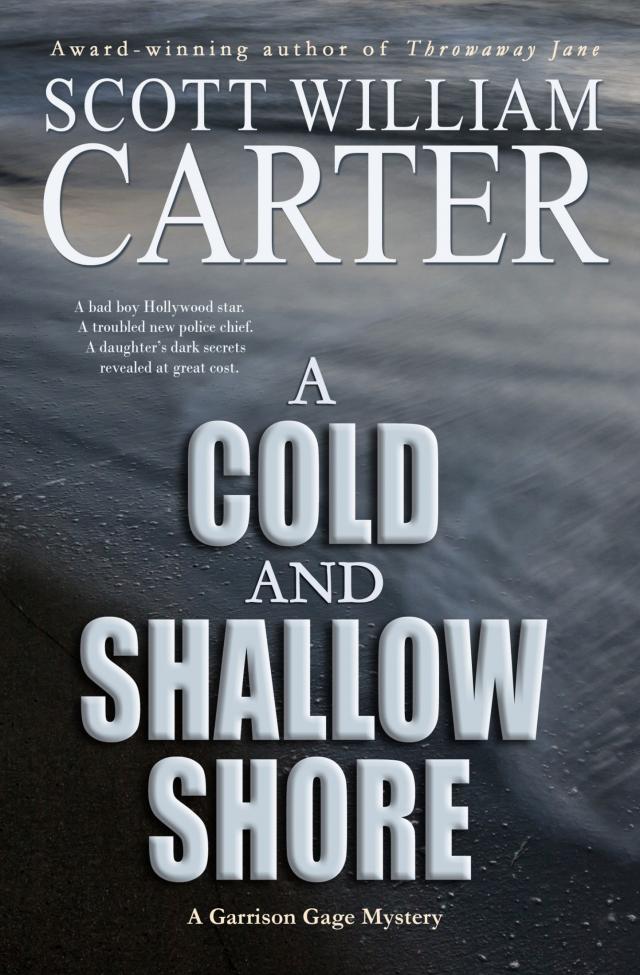


A Cold and Shallow Shore
Scott William Carter
Contents
About the Book
Never Miss a New Release!
Garrison Gage Mysteries
Chapter 1
Chapter 2
Chapter 3
Chapter 4
Chapter 5
Chapter 6
Chapter 7
Chapter 8
Chapter 9
Chapter 10
Chapter 11
Chapter 12
Chapter 13
Chapter 14
Chapter 15
Chapter 16
Chapter 17
Chapter 18
Chapter 19
Chapter 20
Chapter 21
Chapter 22
Chapter 23
About the Author
Also by Scott William Carter
About the Book
A Cold and Shallow Shore
Gage hates birthdays. So when his daughter throws him a surprise party on the coldest night the Oregon coastal town of Barnacle Bluffs has seen in years, Gage finds himself in an equally frosty mood. And when a police cruiser stops him as he trudges along Highway 101, minding his own business, he can't imagine the night could get any worse.
Oh, but it does. For the cranky private investigator with the bum knee, it can always get worse.
When the cops collar one of the people closest to Gage for murder, the desperate hours ahead become a frantic push to right a presumed injustice. Add in a daughter’s secret life, a bad boy Hollywood star, and a troubled new police chief with something to prove, and the night doesn't just get worse. It forces a quickly unraveling Gage to choose between cold, uncomfortable truths—about himself, about someone he loves—and shallow but comforting deceptions.
Never Miss a New Release!
Sign up for the author’s email list and never miss a new release. Your email will never be shared, you can unsubscribe at any time, and you will only be emailed a few times a year. Plus get special offers available only to fans!
* * *
Sign up here:
scottwilliamcarter.com/news
Garrison Gage Mysteries
The Gray and Guilty Sea
A Desperate Place for Dying
The Lovely Wicked Rain
A Shroud of Tattered Sails
A Lighthouse for the Lonely Heart
Bury the Dead in Driftwood
A Deep and Deadly Undertow
A Cold and Shallow Shore
A Cold and Shallow Shore. Copyright © 2022 by Scott William Carter. Published by Flying Raven Press, January 2022, 4742 Liberty Road South, No. 382, Salem, Oregon, 97302.
* * *
All rights reserved, including the right of reproduction, in whole or in part in any form. This book is a work of fiction. Names, characters, places and incidents either are products of the author’s imagination or are used fictitiously. Any resemblance to actual events or locales or persons, living or dead, is entirely coincidental. Cover designed by FRP Productions Department. Cover illustration 108411010 / Sunset on Oregon Coast @ John Anderson | Dreamstime.com
* * *
Visit our website at www.flyingravenpress.com for more information about this book and other titles for sale.
For D.L.
* * *
Who taught me a lot
about voice and character
and gave me many fun nights
with K&G.
1
It was a quarter to eight when the police cruiser skidded to a stop in front of him, just fifty feet ahead of where Gage had been walking along Highway 101.
The Ford Explorer’s tail lights glowed a crisp, clear red in the night air, no fog at all, something of a rarity lately on the Oregon Coast. His fingers, clutching his cane, felt so numb that they ached when he tightened his grip. There was no traffic. No reason to stop other than him. The highway was so still that the sound of the surf, on the other side of the metal barrier and far below, was a roar even though the ocean was at low tide.
He’d remember the time later because he’d just looked at his watch, a gift from Zoe for last year’s birthday, and because he’d been both relieved and disappointed at the time. He’d been relieved because, as a general principle, he didn’t like to be late. He was disappointed because, as a matter of personality, he didn’t like parties, especially ones thrown in his honor.
It was dark and cold and he was in no mood for any kind of nonsense. He’d had more than enough nonsense tonight already. Two cops in uniform, both young and male, got out of the cruiser. Gage had never seen either of them before. That wasn’t a surprise, really. They were a blur to him, these young cops, mostly interchangeable, earnest and well-meaning to the point of nausea. Whatever factory produced them seemed to have an endless supply.
“Garrison Gage?” the cop on the left said.
“It has some nice alliteration, doesn’t it?” Gage replied. He didn’t like how the cop had his hand on his holster. “What’s this about, officer?”
They approached, cautiously. He wondered if they perceived his cane as a weapon. He hated that he had to use his cane at all—he preferred to get by without it, when possible—but the cold air was wreaking havoc on his knee. It felt like a bundle of thumb tacks roped together by his own nerves.
“Were you at Tsunami’s tonight, sir?” the cop on the left said. He was taller than his companion, and his brown hair was cut so short that his scalp looked pale orange in the glow from the cruiser’s tail lights. “About an hour ago?”
“Why do you ask?” Gage said.
“Just answer the question, sir.”
“You’re worrying me, son. But yes, I was there.”
“All right, sir. Could you come with us, please? Back to the station?”
Gage hesitated. His relationship with the Barnacle Bluffs police had never been good, but it had become downright atrocious after Chief Percy Quinn died and the lead detective, Bob Brisbane, was put in charge until a successor could be found. It hadn’t helped that Gage had spent most of his years in town referring to Brisbane, who generally looked like he slept in a dumpster, with such affectionate endearments as Tweedle Dumber, Frumpy Dwarf, and The Homeless Heartthrob.
A Toyota Highlander towing a small pop-up tent trailer rumbled past them from the other direction, pushing a wall of air that forced Gage to lean hard into his cane. The cops, visible in the glare only as black silhouettes, wobbled like cardboard cutouts.
“Can I ask why?” Gage said.
The cops exchanged glances. The one on the left cleared his throat.
“It would be better if you came to the station, sir,” he said. “The chief is hoping to, um, hear your side of the story before charges are filed.”
Gage grimaced. He had figured Brisbane had something to do with this. “Listen, boys, if you’re not actually arresting me right now, then I’m not going anywhere with you until you tell me what this is about.”
They exchanged another glance. The cop on the right shrugged. The cop on the left sighed and opened up a tiny notebook.
“At 6:48 p.m. tonight,” he said, “according to, um, several witnesses at the scene in Tsunami’s parking lot, you … um, you urinated on the hood of a white Chevy Malibu. When you … were confronted by the owner of the vehicle, you fled north on Highway 101 and disappeared down Tide Pool Road, eluding capture.”
“Oh God,” Gage said.
“Will you come with us now, sir?”
“It wasn’t me,” Gage said.
“Your description matches what the owner of the Chevy Malibu gave us. And the other witness identified you by name, sir: Garrison Gage.”
“That’s just the thing. You’ve got the wrong Garrison Gage.”
“Excuse me?”
Gage couldn’t believe this. The evening had started so strangely as it was, and now it felt like he was in one of those Twilight Zone–type shows that Zoe liked so much. He sighed. “Look, can I just come down to the station in the morning? It’s going to sound really weird, but it’ll take a while to explain, and I’m going to be late if I don’t get going. Tell Chief Brisbane—”
“Brisbane is no longer our chief, sir.”
“What?”
“Chief Roland started yesterday.”
This was news to Gage. He hadn’t even heard the name much less knew the selection was even close to being made. He suppressed his irritation that he was first learning about this from the cops themselves, especially considering his inside connection on the job search, and focused on the matter at hand: getting them to put this whole thing off until morning. Pissing off a new police chief was one thing. Pissing off Zoe, after how fragile his relationship with his daughter had been lately, was another.
“I promise to cooperate fully tomorrow, okay?” he said. “You know where I live. I’m not going anywhere. And trust me when I say the guy you’re after won’t be hard to find. Tell your new chief of police to apologize to the owner of the Chevy Malibu, but that it wasn’t me. I’ll be down first thing in the morning to—”
“That’s just the thing, sir,” the cop on the left said. “The problem is that the owner of the Chevy Malibu is our new police chief.”
2
An hour earlier, Gage watched himself walk into the bar. He had a good view. Tsunami’s, which had recently changed hands for the third time in four years, was seldom busy, but it definitely wasn’t busy on a Tuesday in February. There was nobody at the wagon wheel tables between Gage, who sat alone at the back of the room, and the man in the black leather jacket and brown fedora who’d just stepped out of the cold.
It was particularly cold for the Oregon Coast, cold enough that the man’s breath fogged in front of his scowling face as he stepped inside, leaning hard on his cane. Cold enough that Gage felt a blast of chilly air even across the room. Cold enough that his right knee still ached from the ten-minute walk from his house near Highway 101 even though he’d been nursing a bourbon in the warmth of the bar for ten minutes.
The man, this other Garrison Gage, scanned the room with a wary eye, his scowl deepening. Gage wondered why, exactly, the guy was taking so long. Was it really that hard to spot his own doppelganger in a bar occupied by three other patrons, one a geriatric Hell’s Angel has-been slumped over his motorcycle helmet at the bar, the other a WASPish-looking couple lingering at the jukebox, probably Portlanders on vacation, who kept glancing at the wooly haired biker as if they expected to be mugged?
Gage also wondered if he really scowled that much. He pegged himself as more of a frowner than a scowler. When other-Gage finally limped his way to the table—a limp worthy of Quasimodo, all lurch and no style—Gage was already regretting that he’d agreed to do this. Any of this.
“Maybe this was a mistake,” he said.
The man dropped his fedora on the table next to Gage’s own matching fedora, revealing brown hair streaked with an alarming amount of gray. Gage knew his hair wasn’t that gray. He looked at himself in the mirror daily at least once. His jaw also wasn’t quite that square, nor his chest quite so broad and muscular, but he was less bothered by these differences. A certain creative license was expected, of course. But did his white tennis shoes really look that hideous when paired with his blue jeans? Zoe had been telling him this for years, but he’d never believed her.
“Maybe this was a mistake,” the man said, nodding sagely. With a scowl. Always with a scowl. He dropped himself into the chair across from Gage with the same sort of shrugging indifference as when he’d dropped his fedora on the table. “Maybe this was a mistake,” he said again.
“You think so too?” Gage said.
“You think so too?” the man said.
Gage leaned back in his chair and scowled. Then he realized he was scowling and tried to frown instead. He couldn’t tell if he was frowning or scowling, so he gave up and just stared. “This is some kind of method acting, I take it?” he said.
“This is some kind of …” the man started, then stopped and blinked a few times. When he spoke again, it was with a heavy Australian accent. “Oh, sorry, mate, I been watching YouTubes of you all day, practicing your delivery, so I kinda slipped into it there. I’ll hit pause a bit.” He nodded at the shot glass in front of Gage. “Bourbon, right? I figured you more of an on-the-rocks sort a bloke, but it looks like you take it neat.”
It was such a remarkable transformation, not just with the voice but with the whole physical demeanor, that Gage was momentarily taken aback. Gone was the scowling, slumping, curmudgeonly Garrison Gage imitator. In his place was a smiling, cocky, jovial celebrity who looked just at ease in this grungy bar with the wood shake walls as he’d looked strolling the red carpet for the premiere of that last zombie sequel he’d starred in. Zombies Eat Los Angeles or whatever it was. They were all “Zombies Eat” something.
“There are YouTube videos of me?” Gage asked.
“Sure, mate, from some interviews you did about the God’s Wrath cult stuff a couple years ago. I’m Luke Bowden, by the way.” He chuckled. “Guess you probably already know that, though, right?”
“Right,” Gage said. “The name was in your agent’s email.”
Bowden, still smiling, blinked slowly a few times, and there was a moment there, a flicker between those blinks, when Gage saw a flash of something—anger, rage, just a blip—but it was there before Bowden flashed his winning smile again, that roguish grin that had won the hearts of so many fans, especially of the female variety. Still, it was enough to make Gage wary. This was not a man who liked to be teased.
“Ha! Ha!” It was not so much a laugh as a series of articulated barks. Bowden slapped the table hard enough that both of their fedoras jumped. “You’re a funny one, mate. That doesn’t come through in the script so much, you know? Wish they’d put in more humor. But it’s a good part. A real good part. Everybody wanted this fucking part, man, and I made sure I got it.” He signaled to the bartender, a thin kid with tattooed arms, then pointed at Gage’s shot glass. “Two more of these, pub man!”
“Actually,” Gage said, “no more for me. I can’t stay long.”
“Aww, don’t say that, mate,” Bowden said. “We’re just getting started. I really appreciate you meeting me. I have so many questions, you know? I really want to get this part right. I really do. I want to do it justice. Ha! That’s kind of twofer, saying that. Do it justice. You know, because it’s a show about a private eye, right? Doing it justice. Maybe that’s what they should have named it, Doing Justice. But I like the name. Fage. Has a nice ring to it, right? Kind of like rage and mage mixed together? Which is kind of like the character. What do you think? You like it?”
The guy was talking a mile a minute, and he hadn’t even had a drink. Or maybe he had. It was hard to smell alcohol on the man’s breath when the guy mostly smelled of cigarettes, plus the bar smelled like beer and whiskey anyway with a hint of pretzels mixed in for good measure, but Gage thought he detected a whiff of something there, something sweet, like a wine cooler.
“Not really,” Gage said.
“Oh.”
“It’s a little too close to my name. People might think it’s about me.”
This caused a real furrowing of the eyebrows. A pursing of the lips. A wrinkling of the forehead. Poor Luke Bowden. Gage had really thrown him a curveball. They were probably about the same age, not young, not exactly old, occupying those middle years where the gulf between two people’s maturity had less to do with the number of times they’d lapped the sun and more to do with how they’d handled life’s inevitable setbacks.
There was something phony and forced about Luke Bowden. Gage sensed it right off. Even as himself, Bowden was still playing a part, a younger version of himself, maybe, someone cockier and more carefree than he truly felt. “But it is about you,” Bowden said finally.
“Don’t remind me,” Gage said.
“I don’t get it, mate. If you didn’t want the publicity, why did you, you know, sell Silverstar the rights to your story? Was it just for the money?”
It was a good question, one Gage might have even answered if he’d been talking to someone else or if he’d been in a more charitable state of mind, but since he wasn’t talking to someone else, and he definitely wasn’t in a charitable state of mind, he opted for a shrug. Bowden, still struggling with this apparent contradiction, fidgeted with Gage’s fedora. It was definitely Gage’s fedora. Even though they were both brown felt Pendelton’s with black leather bands, Gage would have known his hat anywhere. It was his hat. A man should know his hat.
His was also worn, lived in, beaten up, used. Bowden’s had just come off the rack. He wondered if Bowden was confused or if he was planning on stealing Gage’s hat. Another method thing.
The bartender showed up and deposited the bourbons on the table. Bowden immediately took his shot and downed it in one gulp. When he did, Gage pulled his hat a little closer to himself. He may have lost part of his soul signing that stupid contract, but he wasn’t going to lose his hat. He had to draw a line somewhere.