Orange crush, p.1
Orange Crush, page 1
part #3 of Serge Storms Mystery Series
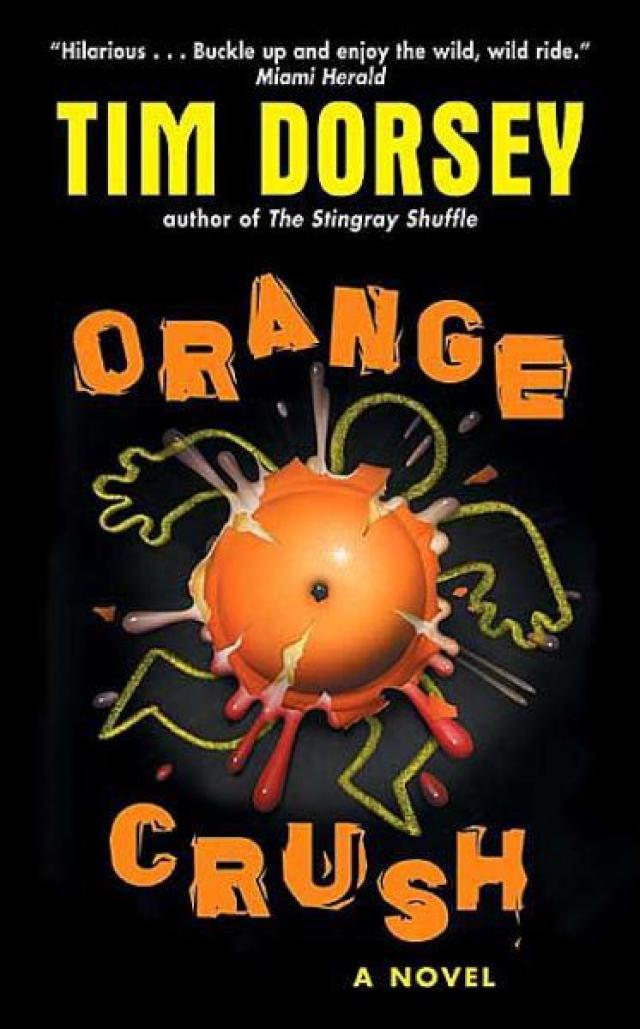


ORANGE CRUSH
Tim Dorsey
For my mother and father
Man is what he chooses to become.
John Spenkelink
Acknowledgments
Thanks are owed to my agent, Nat Sobel, and my editor, Henry Ferristwo people you definitely want on your side in the alley fight that is the book business.
Prologue
With three weeks to go in the Florida governor’s race, the Tallahassee morning newspaper ran the following headline: 2 HEADS EXPLODE IN SEPARATE INCIDENTS
Tallahassee is the capital of Florida, up in the north end of the state near Georgia. The land is less flat, more wooded; the people not as hurried or transient. In the eighteenth century the population centers of old Florida were Pensacola in the panhandle and St. Augustine on the Atlantictoo far apart to be managed under a single provisional government. Officials went looking for a spot in between. But the Talasi Indians were already on that spot, so the officials told the Indians they needed to borrow their village for about three hundred years.
Tallahassee was established the capital in 1823. East Tallahassee High School was established in 1971. On a balmy October evening in 2002, a banner hung in the high school’s auditorium: GO FIGHTING SENATORS! Another hung over the stage: WELCOME GOVERNOR CANDIDATES.
A smattering of people sat in the sea of folding chairs on the basketball court. Technicians taped electrical cables to the parquet floor and checked the sound system. Agents swept the school with bomb-sniffing German shepherds. Reporters shuffled around in a tight herd, stepping on each other’s shoelaces, interviewing The Man on the Street, then each other, looking for that fresh Pulitzer angle. The debate was less than two hours away.
The majestic old Florida Capitol building, with its trademark red-and-white Kentucky Fried Chicken awnings, stands proudly at the foot of the Apalachee Parkway. Behind it is Tallahassee’s only skyscraper, the new Capitol, a sterile monolith built of the finest materials someone else’s money could buy.
At 5:46 P.M., a man in a dark suit and dark sunglasses stepped out a side service door of the Capitol and held it open. A platoon of ten identically dressed men jogged out of the building. The tallest one had a stopwatch and wireless headset, and just as he reached Pensacola Street, a black super-stretch limo screeched up to the curb. The man with the stopwatch opened the back door of the limo, scanned the surroundings, and turned to the rest of the men, who had taken up sentry positions across the Capitol lawn. He twirled a finger in the air, followed by a series of third-base-coach signals. A clutch of elegantly dressed men and women emerged from the service door. The array of sentries collapsed around them to form a circle of human shields, then hustled the group to the curb and shoved them in the back of the limo, which sped north on Monroe Street. A pair of forest-green Hummers joined the limo, an escort in front and a trail vehicle in back. Two small flags snapped in the wind on each side of the limo’s hood. The flag on the right corner displayed the seal of the Florida governor’s office. The flag on the left used to have the same seal but now read: “The Outback Steakhouse Florida Governor’s Race.”
Local law enforcement was worried about security. Due to the state’s proliferation of military assault weapons, violent narcotics gangs and middle-aged loners in one-bedroom apartments, the capital police force reported it was no longer capable of providing what it deemed was adequate security for the governor, lieutenant governor and their families and mistresses. They said they knew of only one group who could get the job done.
The governor’s office hired the people who handled security for the Rolling Stones.
The governor and staff were violently tossed left, then right as the limo slalomed the back roads of Tallahassee in textbook UN convoy maneuver. The governor and his campaign manager faced each other in the posh opposing backseats. The manager flipped flash cards.
A bright yellow card: “Wetlands Despoilment.”
The governor scratched his head. “We for or against that?”
“For,” said the manager. “You feeling okay? That’s the third easy one you’ve missed.”
The governor nodded, but his thoughts were elsewhere. A political world that had been second nature his entire life now seemed alien, oblique, clumsy. He felt light-headed, and the periphery of his vision dissolved with a hallucinatory tinge. He looked around the spacious interior of the limo, packed with the usual suspects. The leather bench seating seemed to go on forever, all the way up to the chauffeur’s soundproof partition, like a hall of mirrors. The governor squinted and took a hard look for the first time. Who the hell were all these people? They stared back at him, smiling and noddinghandlers, trainers, therapists, linguists, donors, spokesmen, media consultants, speechwriters, image makers, spin doctors, crisis teams, spiritual gurus, food tasters, pollsters, pundits, wags, wonks, interstate bagmen, unindicted co-conspirators, miscellaneous hangers-on, and three bimbos who looked like the Mandrell Sisters.
The campaign manager snapped his fingers in front of the governor’s face.
“Wake up! I have some people I want you to meet.”
The manager patted a bald man on the back. “Governor, this is Big Tobacco.” The manager then pointed to others who had wiggled their way back from the forward seats and now crowded shoulder to shoulder in the rear of the limo. “And this is Big Oil, Big Sugar, Big Insurance and Big Rental Car…”
The limo approached a sprawling compound north of the Tallahassee limits. A guard waved them through the twin white metal gates with musical notes that replicated the entrance at Graceland. The vehicle entered a tunnel of nineteenth-century oaks. The residence sat on an elevated blufften thousand square feet, three stories, brick, with portico and columns of Federal architecture. One hour until the debate, one last stop. Fund-raising. A high-end cocktail reception at the home of a man who needed no introduction other than “Perry.”
Periwinkle Belvedere, the most influential lobbyist and political tactician in the state of Florida, who only drank mint juleps.
Perry would have been imposing, even frightening, if it wasn’t for his gamma-ray smile. Six-four and full head of obscenely red hair. He was trim, but his hands and head were extra-large, and he greeted everyone with a fluid personal manner and a handshake thatthrough years of practiceprecisely matched the pounds per square inch of his guest’s.
Power was everywhere in Tallahassee. Political, industrial, sexual. Puddled up all over the city. Periwinkle simply connected the puddles and organized the water. Soon he had a raging river on his hands, which he dredged, dammed, reservoired and viaducted according to his fee schedule.
But the times were changing. Laws limiting gifts, requiring disclosures, a full public accounting. The fun had already started to wheeze out of the capital balloon. Perry was mingling in the library, trying to hide his irritation at the legislators peeking through the blinds and curtains every few minutes, keeping an eye out for reporters like lookouts at a safe-cracking. Journalists, thought Perry, now there’s an attractive bunch. They could put a damper on an orgy.
If ever a place had an orgy in mind, it was Perry’s. The Roman fountain in the foyer pumped Dom Pérignon. Inside the dining hall and out on the torch-lit patio: tables almost collapsing under Keys lobsters, beluga caviar, Périgord truffles, Peking duck and Alaskan salmon. All top-shelf, except for the two Sterno trays at the end of the last banquet table, specially ordered by Periwinkle to cater to the particular tastes of the Florida speaker of the house. Pigs-in-a-blanket and Beenie Weenies.
When the lawmakers first reached the buffet tables, there was aggressive jockeying, the bright glint of cutlery and serving ladles, and finally a blinding piranha frenzy. In minutes, it was quiet again. The aftermath was chilling. Salmon stripped to the spinal column. Blue cheese chunks bobbing in the punch bowl. Beluga flung across the linen like coffee grounds. Cocktail sauce splattered mob-hit-style.
But what really inspired Perry’s awe was their Light Brigade desiccation of the open bar. “My God,” he said in a reverent, hushed tone. “They’re worse than sportswriters.”
No matter how many parties Perry threw, he couldn’t get over one of nature’s marvels, the sights and sounds of lawmakers at the trough, storing up complex carbohydrates for the winter in their woodchuck cheeks and distensible pelican throats. Early on, Perry learned that perks had a curious Bermuda Triangle effect on lawmakers, sending the instrument needles spinning in their judgment cockpits. It worked out to about a dime on the dollar. Fifty bucks of complimentary food, drink and knickknacks bought as much influence as a five-hundred-dollar campaign contribution.
Despite the adorable government-in-the-sunshine reforms, Perry’s soirée tonight began to show signs of life, and a smile crossed his face as the foyer echoed with the hollow din of clinking glasses, self-important laughter and cell phones.
Another cell phone went off, and a half-dozen people at the petit fours checked their jackets and purses. The ones who came up with nonringing phones winced in public shame; the one with the activated phone smirked.
The smirk belonged to Todd Vanderbilt, who answered his cell phone loudly for the benefit of those around him: “It’s your dime!”
Todd was Perry Belvedere’s top lobbyist, and his cell phone rang every five minutes because he told his personal assistant to “call me every five minutes.”
“What do I say?”
“You don’t say anything.”
“I don’t understand.”
“I know.”
Between phone calls, Toddâ €™s beeper went off. So did his Palm Pilot, Sky Pager and self-correcting wristwatch, receiving microwave data from the Atomic Clock in Colorado.
Another alarm went off somewhere on Todd. He reached in his jacket, pulled out an e-gizmo and grinned at the crowd. “Stock split!”
“Ha!” countered a rival. “The market’s closed!”
“Tokyo,” said Todd.
“Ooooooooooo,” the impressed crowd responded, then clapped.
Todd was everything Tallahassee was looking for: young, handsome, ambitious and completely full of shit. From his wardrobe to his manicure, everything was consciously in place. Except for one puzzle piece. The girl on his arm. His date was Sally Brewster, Perry Belvedere’s accounting wizard. She was twenty-three, which was right in Todd’s usual kill zone, but that’s where it ended. Sally had scored something like a million on her SATs and graduated magna cum laude from Princeton, where she had a full scholarship and no dating life. There were a number of reasons. Her long hours studying left little time for extracurricular activity. And she had a nose like a stromboli.
Consequently, Sally remained awkward and frumpish. Her brown hair was straight and stringy, and her clothes looked like the uniform at a Cracker Barrel. She was also sweet as they come. And when a girl is as intelligent and nice as Sally, naturewith its charming brand of whimsymakes her have a crush on a guy like Todd.
Sally had hovered around Todd for months, running to get him coffee, baking him cookies and banana bread, laughing at jokes that were at her expense. He routinely took out frustrations on her because she was the path of least resistance, and she forgave him.
Last Friday morning, Todd checked the market action on his office computer and chewed with his mouth open. Sally stood demurely with a baking tray.
“Killer brownies,” said Todd, still chomping. “Hey, you wanna go to Perry’s party with me next week?”
Todd thought Sally had gone into anaphylactic shock.
He got her a chair and a glass of water. “Tell me if you’re gonna be sick, okay? ‘Cause I can’t get anything on this tie.”
Sally spent the next week shopping. She ran up charges for clothes, her hair, everything. Even was fitted for contact lenses so she could ditch the granny glasses.
It would be nice to say the change was stunning, and that Sally emerged like a beautiful swan. It was not to be. She looked as natural and graceful as a rusting robot, stiffly hobbled on high heels, blinking rapidly from new contacts and bumping into things.
Periwinkle Belvedere glanced from his watch to the doorway, waiting for the governor. Standing with him was Elizabeth Sinclair, Perry’s office manager. Todd Vanderbilt may have been Perry’s hottest lobbyist, but Elizabeth was the glue of maturity that held his staff together. Dignified dark business suit and pearl stud earrings. Blond hair in a short, conservative Meg Ryan cut. She was forty-eight years old, wondered why she was still single, and remembered why every time she came to one of Perry’s parties.
“You certainly look nice tonight,” said Perry.
“Thank you,” said Elizabeth.
“Although we talked about your clothes.”
“I know.”
“I really wish you’d wear something a little more…”
“More what?”
“You know.”
“No, I don’t.”
Perry sighed. “Why can’t you be a team player like Todd?”
Elizabeth and Perry looked over to the faux fireplace, where a series of electronic beeps, pulses, tones and buzzers were going off all over Todd, who smiled and produced a device in each hand and announced: “The sound of success!” He flicked open the cell phone. “It’s your dime!”
Elizabeth turned to Perry. “Your star pupil.”
Perry shook his head. “Look, I’m depending on you” Something across the room caught his eye and he perked up. “Here comes the governor. Try to be nice.”
Heads turned as the state’s chief executive crossed the ballroom. His campaign manager and press secretary trailed close behind, whispering over his shoulders, overlapping each other, identifying people just before the governor shook their hands.
“There’s Helmut von Zeppelin, mega-developer…”
“And that’s Marshall Bellicose Leghorn, cattle baron…”
“Here’s ‘Little Tony’ Mezzanine, local organized crime…”
“And this is Elizabeth Sinclair, Belvedere’s office manager…”
Sinclair smiled with professional distance. “Pleasure to see you again, Governor.”
She braced as they shook hands, determined to keep grinning through anything. She remembered shaking hands with him at the last party. “Wow, lady, that’s some grip you got on ya. Bet it comes in handy, if you know what I mean.” Wink.
The memory made her shiver.
Tonight, the governor shook her hand deferentially and averted his eyes. “Nice to see you again.”
That’s weird, she thought.
Suddenly, the governor and Elizabeth were knocked off balance as Sally Brewster crashed into them. The pair steadied Sally before she could topple off her high heels.
“You okay?” asked the governor.
“New contacts,” said Sally.
Elizabeth fixed Sally’s bra strap so it wouldn’t show. “Let’s get a glass of wine.” She turned back to the governor: “It was nice seeing you again.”
The women moved to the bar and ordered cabernet.
“I’ve got some comfortable shoes out in the car,” offered Elizabeth, her bunched eyebrows betraying acute sympathy for her spastic friend.
“No, I’ve got to do this.”
“You’re way too smart and pretty for a jerk like Todd. What do you see in him, anyway?”
Sally just gave her that smitten look. It reminded Elizabeth of her own youth. Easier to reason with a wild bandicoot than a crush.
“You got it bad,” she said, and they touched wineglasses.
They sipped quietly next to a row of potted ficus flanking the bar. A familiar voice boomed from the other side of the trees.
“Come on, guys, fork it over! We had a bet!”
Elizabeth and Sally peeked through the leaves. It was Todd and two of his buddies, who pulled currency from their wallets and handed it grudgingly to Todd.
“Okay, okay, you win,” said one of the buddies. “You definitely have the dorkiest date at the party.”
Sally put a hand over her mouth, started crying and ran from the party, but not before slamming into the governor again and taking an ugly tumble down the front steps.
Elizabeth marched around the end of the trees. “You son of a bitch!”
“What?” said Todd, then turned to see people running to help Sally. “Oh, her? She’ll get over it. She didn’t honestly think someone like me would actually go out with her. You see the honker on that chick?” Something began beeping. “Hold on, I got a call.” He flicked open his phone. “It’s your dime!”
Elizabeth dumped her glass of cabernet on his chest.
“Hey! My shirt!”
She stomped off.
Todd stared down in horror at the purple stain spreading like a gunshot wound. Something walked by that made him forget about laundry. His eyes followed the lithe figure across the room. She was a Latin beauty with short hair and a nametag from the Brazilian embassy.
“Salsa!” Todd said to himself. He licked his index finger, touched it to an imaginary location in the air and made a hissing sound. “Spicy hot!”
He trotted after her.
In the next room, a senator from Hialeah peeked through the blinds and saw what he had been dreading all nighta reporter talking to the guard in the driveway, gesturing at the house with his notebook. The first ant at the picnic.
A minute later two more reporters arrived, then a few more, and soon a large motley throng clamored in the driveway. The senator closed the blinds and discreetly informed his colleagues:
“RAID!”
They scattered in all directions. People ran into each other; women lost their heels. The Florida speaker of the house stuffed a handful of pigs-in-a-blanket in each coat pocket, gripped another in his mouth, and joined the stampede spilling across the mansion’s driveway.
Cars patched out, fishtailing on the lawn. Senator Mary Ellen Bilgewater was ambushed before she could get to her Saab. She came up swinging. “How dare you ruin this party! We deserve this! People don’t understand the sacrifice it takes…”starting to sob”…you don’t know how hard it is being a lawmaker! You just don’t get it!”