The savage deeps, p.1
The Savage Deeps, page 1


Praise for Timothy S. Johnston’s THE WAR BENEATH
“If you like novels like The Hunt for Red October and
Red Storm Rising, you will certainly enjoy The War Beneath.”
—A-Thrill-A-Week
“If you’re here for thrills, the book will deliver.”
—The Cambridge Geek
“. . . an engaging world that is highly believable . . .”
—The Future Fire
“This is a tense, gripping science fiction/thriller of which
Tom Clancy might well be proud . . . When I say it is gripping,
that is the simple truth.”
—Ardath Mayhar
“. . . a thrill ride from beginning to end . . .”
—SFcrowsnest
“. . . if you like Clancy and le Carré with a hint of Forsyth
thrown in, you’ll love The War Beneath.”
—Colonel Jonathan P. Brazee (RET),
2017 Nebula Award & 2018 Dragon Award Finalist
“Fast-paced, good old-fashioned Cold War espionage . . . a great escape!”
—The Minerva Reader
“One very riveting, intelligent read!”
—Readers’ Favorite
First Edition
The Savage Deeps © 2019 by Timothy S. Johnston
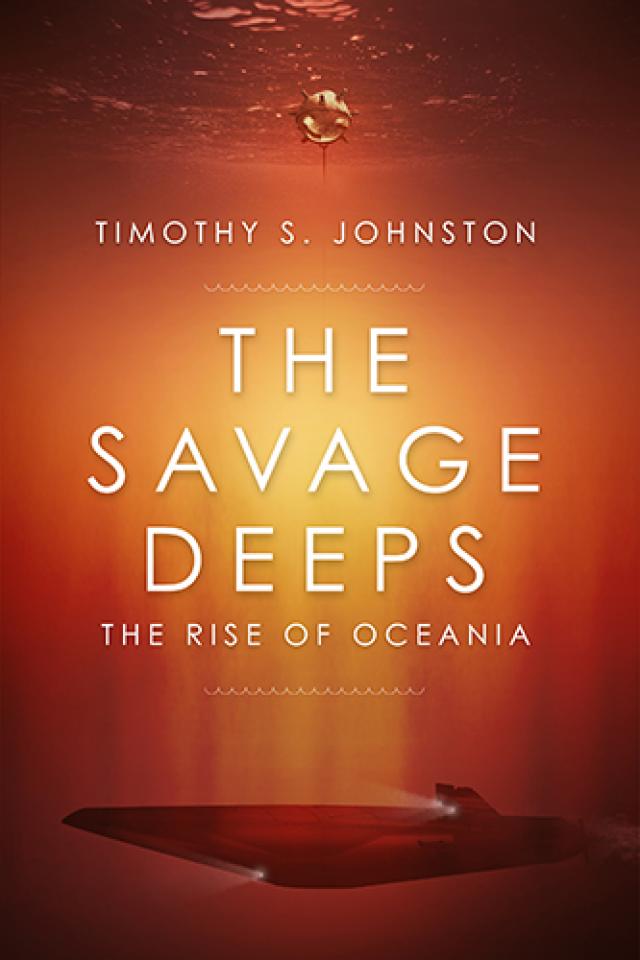
Cover art © 2019 by Erik Mohr (Made By Emblem)
Cover design © 2019 by Jared Shapiro and Errick Nunnally
Interior design © 2019 by Jared Shapiro and Errick Nunnally
All Rights Reserved.
This book is a work of fiction. Names, characters, places, and incidents are either a product of the author’s imagination or are used fictitiously. Any resemblance to actual events, locales, or persons, living or dead, is entirely coincidental.
Distributed in Canada by
Fitzhenry & Whiteside Limited
195 Allstate Parkway
Markham, Ontario L3R 4T8
Phone: (905) 477-9700
e-mail: bookinfo@fitzhenry.ca
Distributed in the U.S. by
Consortium Book Sales & Distribution
34 Thirteenth Avenue, NE, Suite 101
Minneapolis, MN 55413
Phone: (612) 746-2600
e-mail: sales.orders@cbsd.com
Library and Archives Canada Cataloguing in Publication
Johnston, Timothy S., 1970-, author
The Savage Deeps / Timothy S. Johnston. -- First edition.
(The rise of Oceania ; 2)
Issued in print and electronic formats.
ISBN 9781771485067 (softcover).--ISBN 9781771485203 (PDF)
I. Title.
PS8619.O488W37 2018 C813’.6 C2018-904662-7
C2018-904663-5
Edited by Leigh Teetzel
Copyedited and proofread by Klaudia Bednarczyk
We acknowledge the support of the Canada Council for the Arts which last year invested $20.1 million in writing and publishing throughout Canada.
Published with the generous assistance of the Ontario Arts Council.
Printed in Canada
Books by Timothy S. Johnston
ChiZine Publications
THE WAR BENEATH
THE SAVAGE DEEPS
FATAL DEPTH (forthcoming)
Carina Press
THE FURNACE
THE FREEZER
THE VOID
Timeline of Events
2020
Despite the fact that global warming is the primary concern for the majority of the planet’s population, still little is being done.
2055
Shipping begins to experience interruptions due to flooded docks and crane facilities. World markets fluctuate wildly.
2061
Rising ocean levels swamp Manhattan shore defenses and disrupt Gulf Coast oil shipping; financial markets in North America become increasingly unstable due to flooding.
2062-2065
Encroaching water pounds major cities such as Mumbai, London, Miami, Jakarta, Tokyo, and Shanghai. The Marshall Islands, Tuvalu, and the Maldives disappear. Refugee problem escalates in Bangladesh; millions die.
2069
Shore defenses everywhere are abandoned; massive numbers of people move inland. Inundated coastal cities become major disaster areas.
2071-2072
Market crash affects entire world; economic depression looms. Famine and desertification intensifies.
2073
Led by China, governments begin establishing settlements on continental shelves. The shallow water environment proves ideal for displaced populations, aquaculture, and as jump-off sites for mining ventures on the deep ocean abyssal plains.
2080
The number of people living on the ocean floor reaches 100,000.
2088
Flooding continues on land; the pressure to establish undersea colonies increases.
2090
Continental shelves are now home to twenty-three major cities and hundreds of deep-sea mining and research facilities. Resources harvested by the ocean inhabitants are now integral to national economies.
2093
Led by the American undersea cities of Trieste, Seascape, and Ballard, an independence movement begins.
2099
The CIA crushes the independence movement.
2128
Over ten million now populate the ocean floor in twenty-nine cities.
2129
Tensions between China and the United States, fueled by competition over The Iron Plains and a new Triestrian submarine propulsion system, skyrockets. The USSF occupies Trieste following The Second Battle of Trieste.
February 2130
Present day.
“I love the sea, born of an inconceivable deluge, because it is made of water. Water, as fluid as our souls, shapeless, enslaved to none but to gravity. Water, welcoming our bodies in a total embrace, setting us free from our weight. Water, mother of all life, fragile guarantor of our survival.”
—Captain Jacques-Yves Cousteau, Ocean Explorer, Inventor, and Innovator
13 February, 2130 AD
Prelude: The approaching storm
Location: The Gulf of Mexico
Latitude: 27º 34' 29" N
Longitude: 54º 56' 11" W
Depth: 25 meters
Vessel: USS Impaler
Time: 2300 hours
The massive warsub hovered silently near the seafloor. Her maneuvering screws were set to station-keeping and an anchor stretched to the sandy bottom. It was ni..ght in the world above, and the ship’s hull shimmered in the murky sea. Fish darted about and kelp swayed just under the vessel. In the half-light filtering through the water, infantry in scuba gear practiced hand-to-hand combat on the bottom, and troops riding swift scooters flitted about. These small vessels had needle guns mounted to their stabilizers, and one by one their operators fired simulated rounds at each other. The murmur of ordered commands from facemask speakers and screams from officers angry at troops not following instructions echoed in the waters closest to the offending soldiers.
The troops reset for another try, and repeated the war game scenario.
Above the nightly training session, the 250 meter–long warsub was in silhouette with the full moon directly overhead. Small bubbles escaped from soldiers’ masks as they wrestled with trainers and as they cried out in pain from perfectly applied wristlocks and arm bars. Torpedo tube hatches on the hull of USS Impaler opened and shut repeatedly during weapons drills.
It had been months of such training exercises; the USSF clearly expected trouble.
Soon.
Inside the warsub, in a small cabin near the bow, Captain Heller and First Officer Lieutenant Commander Schrader sat at a steel table. They had been discussing the crew’s preparedness and the infantry’s training for over an hour before Heller finally pushed aside his notes and set his pen down.
He leveled his hard eyes on Schrader but said nothing.
Schrader shifted under the glare. He had served with the captain for years now and knew the man well. Normally he was calm, bordering on cold, but there were times when his emotions flared like a storm and had the potential to engulf everything and everyone around him.
Schrader worried that something had stirred within the captain lately. Trieste City had consumed him for months. A year earlier, the undersea city had attempted yet another bid for freedom. George Shanks, who had headed up Trieste City Intelligence, and Janice Flint, the former mayor of the city, had launched a battle in the waters around the ocean colony. Many USSF sailors had died in that fight, along with Triestrian citizens and crews from Chinese subs. In the end, Trieste had surrendered and the USSF had arrested Shanks and Flint, but the colony had become a continuing source of concern for Heller.
Eventually Schrader managed, “Sir?”
Heller sighed. “Truman McClusky is on my mind.”
McClusky was now mayor of Trieste, though he had taken part in The Second Battle of Trieste, and in fact had been a major cause of it. He had led Impaler on a grand chase around the world’s oceans, sunk Chinese vessels, attacked an Australian undersea city, killed French and Chinese and American sailors, and yet still he was wandering the travel tubes and cabins o f Trieste freely. In fact, the citizens of the city had elected him as mayor shortly after The Battle.
Even though Trieste was now under USSF control, the military still allowed her people to elect an official to act as a liaison between the USSF and the colonists. The title “mayor” was only a word, though, and didn’t hold much meaning.
“Why’s that?” Schrader asked.
Heller removed his round wire-frame glasses and rubbed his bald head. The sinews in his forearms rippled. He was in his standard USSF blue uniform, but as captain he permitted himself one modification—he kept his sleeves rolled up. “Yes, McClusky is only a figurehead. The people need to feel as though they have a say in issues. We didn’t want them to feel humiliated following The Battle. We don’t want this fight for freedom they can’t win to bubble up again. I don’t want McClusky to try anything.”
“But we’ve beaten them twice.” In fact, Schrader thought, the first time it had happened, the CIA had killed McClusky’s father. The impact that had had on the son hadn’t escaped him.
“Still,” Heller said, “they are continuing the nonsense.”
“Hoping for independence?” Schrader snorted. “That’s ridiculous. With us right here?” He gestured around them, referring to the city just a few hundred meters to the east of their current location. It was a silly motion; they were in the cramped confines of the captain’s office. “We’d crush them again.”
“Obviously.” Heller frowned. “If we ever decided to arrest or kill Mayor McClusky, we would need proof of his treason, otherwise it would cause an uproar with the citizens of the city. They probably elected him to protect him. They worship the man, especially since his father’s assassination in 2099.” He paused, and then said, “Early in The Battle, the Chinese undersea forces fled.”
“But the Chinese lost a lot in the—”
Heller held up a finger. “No. I’m not referring to the Chinese Submarine Fleet. That’s controlled by mainland China. It’s an important distinction. I’m referring to the forces of the Chinese underwater cities. Sheng City and New Kowloon, for instance.”
Schrader considered the information for a few moments. “They don’t have many reserves. They were scared of losing warsubs and sailors.”
Heller took a deep breath and exhaled. “Perhaps.” He studied Schrader’s eyes. “Or they left to prepare for another day. Perhaps the Chinese undersea cities were working with Trieste. Something connected the two colonies.” Another pause. “Or someone.”
Schrader could tell that Heller was still trying to figure it out. And anything Heller put his mind to, he would achieve.
It was inevitable.
Heller said, “Let me introduce you to some people.” He pushed the intercom button on the bulkhead behind him and whispered a command. Then he sat in silence.
Schrader watched him but said no more. He knew Heller liked that he didn’t push, that he knew when to watch and listen.
The muted sounds of the sub echoed in the cabin as they waited. A few clangs, the sigh of the ventilation system, commands over the loudspeaker related to the ongoing training on the seafloor.
And then the hatch slid open and two men stepped over the threshold. A USSF seaman escorted them in.
“That’ll be all, Seaman Abernathy,” Heller said. The hatch slid shut. Then to Schrader: “These are my two spies at Trieste.”
—••—
Schrader’s face erupted into surprise. He knew Heller had been watching Trieste closely, but hadn’t known exactly how closely.
The first man through the hatch was Robert Butte. The last name was pronounced “Beaut.” He was an important government official and well-liked by the citizens there.
Heller looked at Schrader and smiled. The blood had drained from the XO’s face. “You know Robert, obviously.”
“Yes,” Schrader said, still staring at the man. “And you are the USSF’s spy at Trieste?” He shook his head in surprise. “The deputy mayor? McClusky’s right hand man?” The fact the second most powerful person in the undersea city was a USSF informant must have been Heller’s crowning achievement in the year since The Battle.
Heller then pointed to the second man. “This is Rafe Manuel. He works in Trieste City Control with McClusky.”
Schrader now turned his attention to the second man. “You are also informing for us?”
The man nodded. He was Hispanic with dark eyes wrinkled at their corners. “Yes, Commander Schrader. I work with the mayor and deputy mayor there. I—”
Heller interrupted. “You told me over coded message that you had some information about what McClusky is up to.”
Manuel swallowed. “Yes. He has been sending subs out to the Atlantic. These subs don’t come back.”
“What do you mean by that?” Schrader asked, perplexed.
Heller responded. “He means they’re going to some secret location. A hidden base perhaps, and the independence movement at Trieste is doing something there. I mean to find out what.”
Schrader stared at the men standing before them. Heller was clearly convinced there was still an independence movement, and Schrader was too smart to question his captain about it right then. But it did surprise him. “Do either of you know what it is?”
The reply was in stereo: “No.”
“Do you know where this base is?” Heller asked Manuel.
“Not precisely. They go north. That’s all I know.”
“North.” Heller growled the single word and stared at the man. Manuel could only stare back, but his discomfort was clear.
“That’s right,” he finally replied.
“But why do all sonar reports show the ships going south? Around the curve of South America and out to the Mid-Atlantic Ridge?”
Manuel shook his head. He hesitated and his eyes flicked away for a heartbeat. “I can’t explain that.”
Heller turned to the deputy mayor. “Can you explain it, Robert?”
The man seemed surprised. “I didn’t even know this much, Captain. Rafe here works in Sea Traffic Control. He sees the tracks of the subs. I don’t.”
“And McClusky has never spoken of this mystery to you?”
“No.”
Robert Butte stood ramrod stiff now, and locked eyes with Heller.
Heller looked away and seemed to process this information. “I trust you,” he said finally. Then he slid out from behind the table in one lithe motion and stepped toward Manuel. “On the other hand, I believe that you’re lying to me.” His voice was coarse.
Manuel backed away slightly, but it was difficult in the small cabin. “I’m not—”
In a flash Heller snapped out a hand and locked it around the man’s throat. He squeezed and reeled the man toward him. Manuel was wiry and thin, and no match for Impaler’s captain. “I’m telling the truth,” Manuel gasped.
“Right. The ships are going north. Do you still claim that? Do you not realize we have ships equipped with sonar too?” His teeth were bared and his arm flexed horribly.
Then in one sudden movement he spun the man around and stepped behind him. He kicked at the back of Manuel’s knees, which buckled instantly. Heller held the man in place as he forced him backward precariously. “You’ve been spying for us, but you’re working for McClusky, aren’t you?”
Schrader sat frozen, riveted on the scene, perplexed and shocked at Heller’s sudden display of force. The deputy mayor also seemed astonished.
Silence descended on the cabin as Heller forced the man backward. Gasping air was the only sound now. Manuel’s forehead beaded with sweat as he struggled, but it was useless. Heller had his knee in the man’s spine as he pulled Manuel backward. Creases traced across the captain’s forehead, and his face had turned red. Either in rage or exertion, Schrader couldn’t tell.
Manuel cried out—
And a tremendous crack echoed through the chamber.
Heller stepped away and shoved the man’s limp body to the deck.
But Manuel wasn’t dead. His eyes jerked about in confusion. He was probably realizing his spine had snapped, Schrader thought . . . that Heller had just broken his back with his bare hands.
Heller started to kick him in the face. Again and again the sound of wet thuds filled the cabin. And then he started to stomp on him. And through it all he yelled between gritted teeth, “You were trying to deceive me! You were spying for him and telling me that you were working for us!”