

That distant land, p.1
That Distant Land, page 1


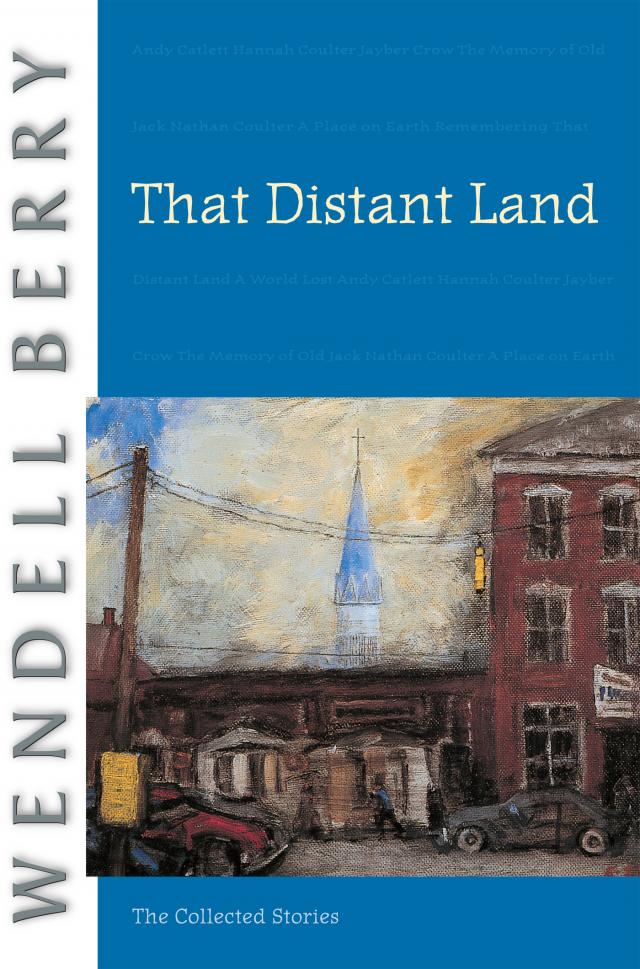
That Distant Land
Copyright © 2004 by Wendell Berry
All rights reserved. No part of this book may be used or reproduced in any manner whatsoever without written permission from the Publisher, except in the case of brief quotations embodied in critical articles and reviews.
This book is a work of fiction. Nothing is in it that has not been imagined.
The author and publisher gratefully acknowledge the editors who have previously published these stories: From The Wild Birds (North Point, 1985): “Thicker Than Liquor” and “The Wild Birds” originally published in Mother Jones magazine.
From Fidelity (Pantheon, 1992): “Pray Without Ceasing” originally published in The Southern Review, “A Jonquil for Mary Penn” originally published in The Atlantic Monthly, “Making It Home” originally published as “Homecoming” in The Sewanee Review, “Fidelity” originally published in Orion, “Are You All Right?” originally published in Wendell Berry. Vol IV in the Confluence American Author Series, edited by Paul Merchant.
From Watch With Me (Pantheon, 1994)” “Nearly to the Fair,” “Turn Back the Bed,” “A Consent,” “A Half-Pint of Old Darling,” and “The Solemn Boy” originally published in The Draft Horse Journal. “A Consent” was also published as a chapbook by Larkspur Press. “The Lost Bet” was published as a chapbook entitled How Ptolemy Proudfoot Lost a Bet by Dim Gray Bar Press.
From Two More Stories of the Port William Membership (Gnomon Press: 1997), “A Friend of Mine” and “The Inheritors” originally published in The Kenyon Review and The Draft Horse Journal.
“The Discovery of Kentucky” was originally published in The Discovery of Kentucky (Gnomon Press, 1991).
“The Hurt Man” was originally published in the Hudson Review.
The author wishes to thank his friends at Shoemaker & Hoard.
Library of Congress Cataloging-in-Publication Data
Berry, Wendell, 1934-
That distant land : the collected stories of Wendell Berry
p. cm.
Hardcover: ISBN-10 1-59376-027-2 ISBN-13: 978-1-59376-027-4
Paperback. ISBN-10 1-59376-054-X ISBN-13: 978-1-59376-054-0
1. Port William (Ky. : Imaginary place)—Fiction.
2. Kentucky—Social life and customs—Fiction
3. Pastoral fiction, American 4. Country life—Fiction. I. Title
PS3552.E75 A6 2004
813'.54—dc22 2003025213
Jacket and text design by David Bullen Design
Map and genealogy designed by Molly O'Halloran
Genealogy prepared by David McCowen
COUNTERPOINT
2560 Ninth St. Suite 318
Berkeley, CA 94710
www.counterpointpress.com
Distributed by Publishers Group West
10 9 8 7
Contents
Italics indicate chronological placement of the Port William novels, which are not included in this collection.
The Hurt Man (1888)
Don’t Send a Boy to Do a Man’s Work (1891)
A Consent (1908)
Pray Without Ceasing (1912)
Watch With Me (1916)
A Half-Pint of Old Darling (1920)
The Lost Bet (1929)
Nathan Coulter (1929–1941)
Thicker than Liquor (1930)
Nearly to the Fair (1932)
The Solemn Boy (1934)
A Jonquil for Mary Penn (1940)
Turn Back the Bed (1941)
A World Lost (1944)
A Place on Earth (1945)
Making It Home (1945)
Where Did They Go? (1947)
The Discovery of Kentucky (1952?)
The Memory of Old Jack (1952)
It Wasn’t Me (1953)
The Boundary (1965)
That Distant Land (1965)
A Friend of Mine (1967)
The Wild Birds (1967)
Are You All Right? (1973)
Remembering (1976)
Fidelity (1977)
Jayber Crow (1914–1986)
The Inheritors (1986)
Hannah Coulter (1934–2001)
That Distant Land
The Collected Stories
I dedicate this book
to the memory
of Wallace Stegner
“Oh that I should ever forget We stood by the wagon saying goodbye or trying to & I seen it come over her how far they was a going & she must look at us to remember us forever & it come over her pap and me and the others We stood & looked & knowed it was all the time we had & from now on we must remember We must look now forever Then Will rech down to her from the seat & she clim up by the hub of the wheel & set beside him & he spoke to the team She had been Betsy Rowanberry two days who was bornd Betsy Coulter 21 May 1824 Will turnd the mules & they stepd into the road passd under the oak & soon was out of sight down the hill The last I seen was her hand still raisd still waving after wagon & all was out of sight Oh it was the last I seen of her that little hand Afterwards I would say to myself I could have gone with them as far as the foot of the hill & seen her that much longer I could have gone on as far as the river mouth & footed it back by dark But however far I finaly would have come to wher I would have to stand and see them go on that hand a waving God bless her I never knowd what become of her I will never see her in this world again”
From Remembering
The Hurt Man (1888)
When he was five Mat Feltner, like every other five-year-old who had lived in Port William until then, was still wearing dresses. In his own thoughts he was not yet sure whether he would turn out to be a girl or a boy, though instinct by then had prompted him to take his place near the tail end of the procession of Port William boys. His nearest predecessors in that so far immortal straggle had already taught him the small art of smoking cigars, along with the corollary small art of chewing coffee beans to take the smoke smell off his breath. And so in a rudimentary way he was an outlaw, though he did not know it, for none of his grownups had yet thought to forbid him to smoke.
His outgrown dresses he saw worn daily by a pretty neighbor named Margaret Finley, who to him might as well have been another boy too little to be of interest, or maybe even a girl, though it hardly mattered—and though, because of a different instinct, she would begin to matter to him a great deal in a dozen years, and after that she would matter to him all his life.
The town of Port William consisted of two rows of casually maintained dwellings and other buildings scattered along a thoroughfare that nobody had ever dignified by calling it a street; in wet times it hardly deserved to be called a road. Between the town’s two ends the road was unevenly rocked, but otherwise had not much distinguished itself from the buffalo trace it once had been. At one end of the town was the school, at the other the graveyard. In the center there were several stores, two saloons, a church, a bank, a hotel, and a blacksmith shop. The town was the product of its own becoming, which, if not accidental exactly, had also been unplanned. It had no formal government or formal history. It was without pretense or ambition, for it was the sort of place that pretentious or ambitious people were inclined to leave. It had never declared an aspiration to become anything it was not. It did not thrive so much as it merely lived, doing the things it needed to do to stay alive. This tracked and rubbed little settlement had been built in a place of great natural abundance and beauty, which it had never valued highly enough or used well enough, had damaged, and yet had not destroyed. The town’s several buildings, shaped less by art than by need and use, had suffered tellingly and even becomingly a hundred years of wear.
Though Port William sat on a ridge of the upland, still it was a river town; its economy and its thoughts turned toward the river. Distance impinged on it from the river, whose waters flowed from the eastward mountains ultimately, as the town always was more or less aware, to the sea, to the world. Its horizon, narrow enough though it reached across the valley to the ridgeland fields and farmsteads on the other side, was pierced by the river, which for the next forty years would still be its main thoroughfare. Commercial people, medicine showmen, evangelists, and other river travelers came up the hill from Dawes Landing to stay at the hotel in Port William, which in its way cherished these transients, learned all it could about them, and talked of what it learned.
Mat would remember the town’s then-oldest man, Uncle Bishop Bower, who would confront any stranger, rap on the ground with his long staff, and demand, “Sir! What might your name be?”
And Herman Goslin, no genius, made his scant living by meeting the steamboats and transporting the disembarking passengers, if any, up to the hotel in a gimpy buckboard. One evening as he approached the hotel with a small trunk on his shoulder, followed by a large woman with a parasol, one of the boys playing marbles in the road said, “Here comes Herman Goslin with a fat lady’s trunk.”
“You boys can kiss that fat lady’s ass,” said Herman Goslin. “Ain’t that tellin ’em, fat lady?”
The town was not built nearer the river perhaps because there was no room for it at the foot of the hill, or perhaps because, as the town loved to reply to the inevitable question from travelers resting on the hotel porch, nobody knew where the river was going to run when they built Port William.
And Port William did look as though it had been itself forever. To Mat at the age of five, as he later would suppose, remembering himself, it must have seemed eternal, like the sky.
However eternal it might have been, the town was also as tempo ral, lively, and mortal as it possibly could be. It stirred and hummed from early to late with its own life and with the life it drew into itself from the countryside. It was a center, and especially on Saturdays and election days its stores and saloons and the road itself would be crowded with people standing, sitting, talking, whittling, trading, and milling about. This crowd was entirely familiar to itself; it remembered all its history of allegiances, offenses, and resentments, going back from the previous Saturday to the Civil War and long before that. Like every place, it had its angers, and its angers as always, as everywhere, found justifications. And in Port William, a dozen miles by river from the court house and the rule of law, anger had a license that it might not have had in another place. Sometimes violence would break out in one of the saloons or in the road. Then proof of mortality would be given in blood.
And the mortality lived and suffered daily in the town was attested with hopes of immortality by the headstones up in the graveyard, which was even then more populous than the town. Mat knew—at the age of five he had already forgotten when he had found out—that he had a brother and two sisters up there, with carved lambs resting on the tops of their small monuments, their brief lives dated beneath. In all the time he had known her, his mother had worn black.
But to him, when he was five, those deaths were stories told. Nothing in Port William seemed to him to be in passage from any beginning to any end. The living had always been alive, the dead always dead. The world, as he knew it then, simply existed, familiar even in its changes: the town, the farms, the slopes and ridges, the woods, the river, and the sky over it all. He had not yet gone farther from Port William than to Dawes Landing on the river and to his Uncle jack Beecham’s place out on the Bird’s Branch Road, the place his mother spoke of as “out home.” He had seen the steamboats on the river and had looked out from the higher ridgetops, and so he understood that the world went on into the distance, but he did not know how much more of it there might be.
Mat had come late into the lives of Nancy and Ben Feltner, after the deaths of their other children, and he had come unexpectedly, “a blessing.” They prized him accordingly. For the first four or so years of his life he was closely watched, by his parents and also by Cass and Smoke, Cass’s husband, who had been slaves. But now he was five, and it was a household always busy with the work of the place, and often full of company. There had come to be times, because his grown-ups were occupied and he was curious and active, when he would be out of their sight. He would stray off to where something was happening, to the farm buildings behind the house, to the blacksmith shop, to one of the saloons, to wherever the other boys were. He was beginning his long study of the town and its place in the world, gathering up the stories that in years still far off he would hand on to his grandson Andy Catlett, who in his turn would be trying to master the thought of time: that there were times before his time, and would be times after. At the age of five Mat was beginning to prepare himself to help in educating his grandson, though he did not know it.
His grown-ups, more or less willingly, were letting him go. The town had its dangers. There were always horses in the road, and sometimes droves of cattle or sheep or hogs or mules. There were in fact uncountable ways for a boy to get hurt, or worse. But in spite of her losses, Nancy Beechum Feltner was not a frightened woman, as her son would learn. He would learn also that, though she maintained her sorrows with a certain loyalty, wearing her black, she was a woman of practical good sense and strong cheerfulness. She knew that the world was risky and that she must risk her surviving child to it as she had risked the others, and when the time came she straightforwardly did so.
But she knew also that the town had its ways of looking after its own. Where its worst dangers were, grown-ups were apt to be. When Mat was out of the sight of her or his father or Cass or Smoke, he was most likely in the sight of somebody else who would watch him. He would thus be corrected, consciously ignored, snatched out of danger, cursed, teased, hugged, instructed, spanked, or sent home by any grown-up into whose sight he may have strayed. Within that watchfulness he was free—and almost totally free when, later, he had learned to escape it and thus had earned his freedom. “This was a free country when I was a boy,” he would sometimes say to Andy, his grandson.
When he was five and for some while afterward, his mother drew the line unalterably only between him and the crowds that filled the town on Saturday afternoons and election days when there would be too much drinking, with consequences that were too probable. She would not leave him alone then. She would not let him go into the town, and she would not trust him to go anywhere else, for fear that he would escape into the town from wherever else she let him go. She kept him in sight.
That was why they were sitting together on the front porch for the sake of the breeze there on a hot Saturday afternoon in the late summer of 1888. Mat was sitting close to his mother on the wicker settee, watching her work. She had brought out her sewing basket and was darning socks, stretching the worn-through heels or toes over her darning egg and weaving them whole again with her needle and thread. At such work her fingers moved with a quickness and assurance that fascinated Mat, and he loved to watch her. She would have been telling him a story. She was full of stories. Aside from the small movements of her hands and the sound of her voice, they were quiet with a quietness that seemed to have increased as it had grown upon them. Cass had gone home after the dinner dishes were done. The afternoon had half gone by.
From where they sat they could see down into the town where the Saturday crowd was, and they could hear it. Doors slammed, now and then a horse nickered, the talking of the people was a sustained murmur from which now and then a few intelligible words escaped: a greeting, some bit of raillery, a reprimand to a horse, an oath. It was a large crowd in a small place, a situation in which a small disagreement could become dangerous in a hurry. Such things had happened often enough. That was why Mat was under watch.
And so when a part of the crowd intensified into a knot, voices were raised, and there was a scuffle, Mat and his mother were not surprised. They were not surprised even when a bloodied man broke out of the crowd and began running fast up the street toward them, followed by other running men whose boot heels pounded on the road.
The hurt man ran toward them where they were sitting on the porch. He was hatless. His hair, face, and shirt were bloody, and his blood dripped on the road. Mat felt no intimation of threat or danger. He simply watched, transfixed. He did not see his mother stand and put down her work. When she caught him by the back of his dress and fairly poked him through the front door—“Here! Get inside!”—he still was only alert, unsurprised.
He expected her to come into the house with him. What finally surprised him was that she did not do so. Leaving him alone in the wide hall, she remained outside the door, holding it open for the hurt man. Mat ran halfway up the stairs then and turned and sat down on a step. He was surprised now but not afraid.
When the hurt man ran in through the door, instead of following him in, Nancy Feltner shut the door and stood in front of it. Mat could see her through the door glass, standing with her hand on the knob as the clutch of booted and hatted pursuers came up the porch steps. They bunched at the top of the steps, utterly stopped by the slender woman dressed in mourning, holding the door shut.
And then one of them, snatching off his hat, said, “It’s all right, Mrs. Feltner. We’re his friends.”
She hesitated a moment, studying them, and then she opened the door to them also and turned and came in ahead of them.
The hurt man had run the length of the hall and through the door at the end of it and out onto the back porch. Nancy, with the bunch of men behind her, followed where he had gone, the men almost with delicacy, as it seemed to Mat, avoiding the line of blood drops along the hall floor. And Mat hurried back down the stairs and came along in his usual place at the tail end, trying to see, among the booted legs and carried hats, what had become of the hurt man.
Mat’s memory of that day would always be partly incomplete. He never knew who the hurt man was. He knew some of the others. The hurt man had sat down or dropped onto a slatted green bench on the porch. He might have remained nameless to Mat because of the entire strangeness of the look of him. He had shed the look of a man and assumed somehow the look of all things badly hurt. Now that he had stopped running, he looked used up. He was pallid beneath the streaked bright blood, breathing in gasps, his eyes too widely open. He looked as though he had just come up from almost too deep a dive.






