

Returning, p.17
Returning, page 17
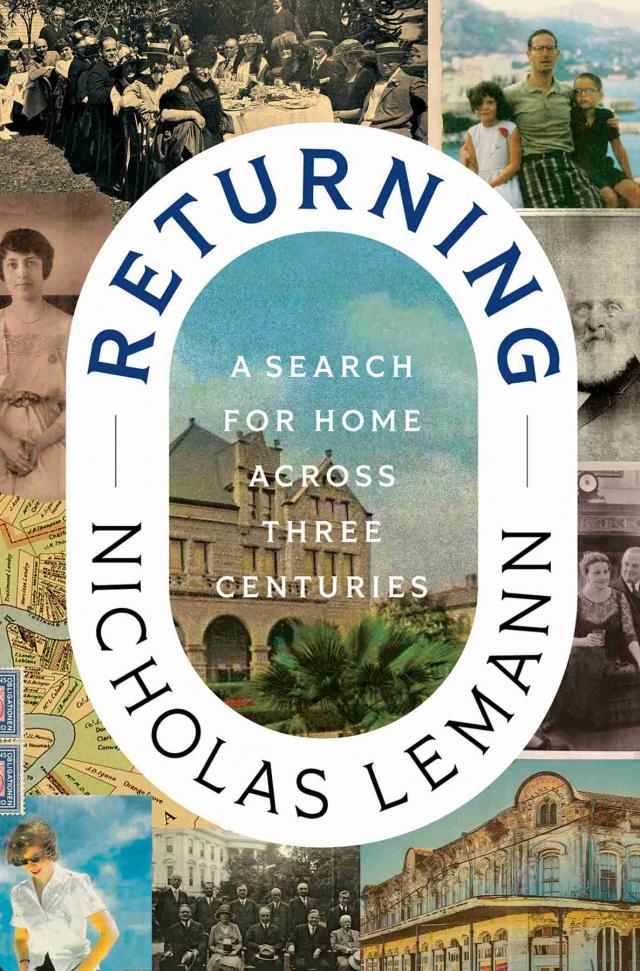


Nettie Hyman Lemann in the 1920s, around age thirty.
Nettie, in Lillian’s telling, was always the favorite. Lillian was given a string of pearls by their parents, only to find that Nettie had been given a more valuable string of pearls. Lillian was taken to a Paris couturier, but she was told that she couldn’t have the dress she most wanted because it was too similar to the dress Nettie had chosen. Nettie was sent to a Swiss boarding school, then returned to New Orleans to make her debut, then was sent to a girls’ finishing school in New York called Miss Finch’s. Father’s version of her life story was that when she returned to New Orleans and encountered Pop, the rising and serious young lawyer, she was worried he would think she was too flighty and insubstantial. So she went to nursing school and became a surgical nurse at Touro Infirmary, a bloody job that wouldn’t have been a standard occupation for a Jewish debutante. Father had a copy of her application letter, which of course doesn’t mention Pop but otherwise matches his version of her life story. Nettie wrote the nursing school:
My home surroundings have been of the most pleasant, and, perhaps, luxurious kind. My parents have given me everything in their power to further my happiness. They have given me great educational advantages, having put me in a boarding school in Switzerland where I might learn French, and also in schools in the East, where I might put the “finishing touches” on the education acquired at High School. Since finishing school I have merely amused myself, having never sought or desired an occupation until this time. My father’s occupation is that of cotton brokerage, and his position has made me free from domestic responsibilities and from the necessity of being a contributor toward the support of my family.
Another result of Nettie’s choice of career besides the marriage, most likely, was that she contracted tuberculosis, another of the diseases that life in Louisiana visited on our family through the years. Her life with Pop looks to me now like a blend of luxury and suffering. The drugs that cure tuberculosis hadn’t been invented. In photographs, as the years pass, Nettie is ever thinner and more drawn, and ever more elegantly dressed. Family letters are full of talk about setbacks, trips to hospitals, gruesome-sounding experimental treatments that don’t quite work. In the 1930s the Sterns built what must have been the grandest house in New Orleans, at the outer edge of the city. It was designed to look like a Palladian villa from the front and a Louisiana plantation house from the back, and was surrounded by elaborate formal gardens. After the Sterns died, Father went to a great deal of effort to have it made into a museum open to the public. The Lemanns were there constantly, and they lived in a large and elegant house of their own in Uptown New Orleans, right around the corner from the house on St. Charles Avenue where Pop had spent the later years of his childhood.
I have the sense that the way of life that had emerged among the German Jews in New York by the early twentieth century took some time to reach distant, provincial New Orleans. In Lillian’s memoir, she describes a childhood of de rigueur attendance at Sabbath services, both on Friday night and on Saturday morning, followed in each case by a holiday meal for the extended family. There was a Passover seder, preceded by days of scrubbing the house to remove any trace of chametz, bread. When a son was born, a wide circle of family and friends came to the house for the bris. When Lillian’s grandparents, in small-town Summit, Mississippi, celebrated their fiftieth anniversary, they reenacted their wedding ceremony with a rabbi presiding. I don’t think a similarly situated German-Jewish family in New York would have done all this. The two institutional associations of Bernard Lemann’s youth in New York City, the gaudily celebratory Purim Association and the anti-Reform Jewish Messenger, went out of business in 1902 and 1903, respectively. They’d become too Jewish for the German Jews.
It’s even more striking that the rabbi at Temple Sinai, Maximilian Heller, the man who gave Pop his boyhood Hebrew lessons, was possibly the leading vocal Zionist in the entire American Reform movement. This would not have been tolerated at Temple Emanu-El, and indeed it wasn’t: in 1903 Heller, fifteen years into his tenure at Temple Sinai, made himself a candidate for the rabbi’s job there. He wrote to a friend that he was “heartily tired of New Orleans” and eager to leave. The friend told him he’d have to play down his Zionism if he wanted the New York job. We don’t know what happened in his job interview, but he wasn’t hired, and he wound up serving for another quarter century at Temple Sinai, where his views hadn’t yet become as unacceptable in the community as they were in New York. Heller had been brought up in the Jewish ghetto in Prague as what we’d now call Orthodox, but in the United States he wound up being trained at Hebrew Union College in Cincinnati.
A loyal protégé to Isaac Mayer Wise, the very Reform head of the seminary (and the officiant at Jacob Lemann’s funeral), Heller waited until a year after Wise had died to reveal publicly his Zionist views. The Reform movement may have renounced the kosher laws in their entirety, but it was not so relaxed on all topics; Zionism was strictly treyf. Heller also spoke out in favor of the immigration of Russian Jews, whom he called “the Hebrew of the Hebrews,” the people who might restore the magic of traditional observance that the Reform movement had cast aside in the vain hope of acceptance. He denounced pogroms in Eastern Europe. He defended Leo Frank (who wrote him a thank-you note). He was also a public champion of civil rights for Black people. W. E. B. Du Bois quoted him in The Crisis. Du Bois’s archrival, Booker T. Washington, invited him to be the commencement speaker at Tuskegee.
Heller finally retired in 1927, the year after Father was born, and soon after that Temple Sinai moved to a large new home in Uptown, designed by Moise Goldstein, Pop’s friend and regular lunch companion at Kolb’s, right across the street from the house Bernard Lemann had built at the end of the nineteenth century. It’s still there, a large square pile of pale brick and stone and cement with decorative embellishments meant to read as “Oriental,” with a seating capacity of more than a thousand and, more in the manner of a church than a synagogue, an organ and a place for a choir (discreetly concealed). Heller had presided over the temple for forty years, since it was only a few years old, and had built it up into a preeminent position in the South. Perhaps that, plus his eminence in the wider world, plus the goodwill he’d built up through the hundreds of weddings and funerals he’d performed, gave him leeway to depart from the majority views of the community.
But it was also true that, at least when he was first appointed, German Jews in New Orleans were not only more free to be openly Jewish than they would have been in New York, they were also, at least as Father handed down the story to me, more fully accepted by the Gentile gentry. According to Father, Henry Abraham, the local representative of the Lehman brothers and father-in-law to Myer Lemann, was a member of the most prestigious of the Mardi Gras organizations, Comus. And there was the famous example of the first Rex, the king of Carnival, having been a Jew. If you accept the thinking of the German Jews in New York, it may have been that because New Orleans was the destination for many fewer Eastern European Jews than New York, it could be a safer haven for German Jews. It’s hard to think of a leading business-law firm in New York in the early twentieth century that had one Christian and one Jewish name partner, as Monroe & Lemann did. Surely Mr. Monroe was happy to be in business with someone who was as bright and well connected as Pop, and Pop must have been essential in acquiring the firm’s important clients who were Jewish, like the Sterns, or J. Aron and Company, a coffee importer that many years later was bought by Goldman Sachs, or Sam Zemurray, a rough and unlettered, but very successful, immigrant Jew from Moldova who was on his way to becoming the king of the banana business.
Outside of New Orleans, as Jewish immigrants from Eastern Europe kept arriving, they—indeed, collectively, Jews—became increasingly upsetting to the better sort of American Gentiles, and those who put their sentiments into words often resorted to the new vocabulary of race science that was becoming part of the lingua franca of their class. Because we are so accustomed to thinking of racism as unacceptable, it’s jarring to encounter its pervasiveness among those who thought of themselves as the better, more progressive sort of people, little more than a century ago. And it’s also jarring to see that among the principal targets of racism back then were people we now think of as white, but who weren’t thought of that way then. Jacob Riis, anything but a voice of conservatism, took the readers of his fiery reformist book How the Other Half Lives (1890) to New York’s Jewish Lower East Side, which he said was the most densely populated square mile in the world at that moment: “Thrift is the watchword of Jewtown, as of its people the world over. It is at once its strength and its fatal weakness, its cardinal virtue and its foul disgrace. . . . Money is their God. Life itself is of little value compared with even the leanest bank account. In no other spot does life wear so intensely bald and materialistic an aspect as in Ludlow Street.” Others who made these journeys into the ghettos came away with similar exotic, disgusted impressions. Poor Jewish immigrants were part of an undifferentiated flood, a swarm, a tide, devoid of individual humanity. Henry James, visiting the Lower East Side a few years after Riis, compared its crowded fire escapes to “a little world of bars and perches and swings for human squirrels and monkeys.” The historian Frederick Jackson Turner found Boston’s North End to be “fairly packed with swarthy sons and daughters of the tribe of Israel.”
When, somehow, a Jew escaped this environment and became prosperous, that didn’t make him any less repellent—if anything, the opposite. He was vulgar, flashy, corrupt, powerful, able to change the whole nature of society for the worse. The aristocratic historian Henry Adams, who began focusing on the Jews after the 1893 financial panic, wrote to a friend, “For the first time in history, the blood is vitiated. The Jew has got into the soul. I see him—or her—now everywhere, and wherever he—or she—goes, there must remain a taint in the blood forever.” Edith Wharton’s fictional characters Simon Rosedale, in The House of Mirth, and Julius Beaufort, in The Age of Innocence, neither explicitly Jewish but both with certain familiar traits (financial expertise, mysterious background, ambition for an undeserved place in high society) are usually assumed to be based on August Belmont, the Rothschild representative who was one of the few Jews who got into range of Wharton’s social world. When F. Scott Fitzgerald, in the 1920s, sent Wharton a copy of The Great Gatsby, with its cameo appearance by a heavily accented Jewish gangster named Meyer Wolfsheim, who wore cuff links fashioned from human teeth, she wrote him, “It’s enough to make this reader happy to have met your perfect Jew.” Even the extremely rare public intellectual who wasn’t actively antisemitic usually felt, as the pioneering Jew-friendly Christian Wilhelm von Dohm in eighteenth-century Germany had, that there was something wrong, something unacceptable, about the Jews one encountered in the mainstream of society. Randolph Bourne, writing in The Atlantic in 1916 as a brave and lonely voice in favor of what we’d now call muliticulturalism, said, “It is not the Jew who sticks proudly to the faith of his fathers and boasts of that venerable culture of his who is dangerous to America, but the Jew who has lost the Jewish fire and become a mere elementary, grasping animal.”
A decade or two into the twentieth century, these attitudes arrived in New Orleans, and when they did, they stuck. Doors that had almost miraculously opened to Jews who aspired to operate outside the confines of the community began to close, after just a few years, and soon the doors to the United States itself substantially closed with the passage of the Johnson-Reed Act, a strict immigration restriction that Congress passed in 1924. In the South, racial ordering was overwhelmingly aimed at Black people, and since it was essential to everything about the operation of society, it was particularly pervasive and entrenched. Other ethnic groups were collateral damage. The largest mass lynching in American history took place in New Orleans in 1911—of eleven Italian immigrants who had been accused, but not convicted, of murdering the chief of police. (Lynchings of Black people were far more numerous, but typically individual.) New Orleans’s German Jews, too, became a little less white than they had been. When you look at Mardi Gras, when you really think about it—its origins during the time Reconstruction was being overthrown and Jim Crow instituted, its heavy use of mystical-nationalist symbolism, its self-conscious adoption of titles of nobility, its cherished custom of parading men through the streets on horseback dressed in hooded robes—it’s hard to imagine how it could have avoided excluding us sooner or later. Like the Louisiana Creoles, only with far milder consequences, the German Jews were being joined to the much larger, poorer, and more obviously visible mass of their ethnic group. With exceptions like the immovably fierce, prophetic Rabbi Max Heller, they responded to this more often through self-isolation than solidarity. And this order lasted in New Orleans far longer than it did in the rest of the country, well into the time when I was growing up. I’ve come to think of this as a gift, in a way: it put me in closer touch with the totality of Jewish experience than Jews who grew up in friendlier circumstances in postwar America were.
“A Supplicant at Many Gates”
In our world, the Pharaoh who knew not Joseph was the grave, lavishly moustachioed Boston Brahmin Abbott Lawrence Lowell, who became president of Harvard in 1909. Lowell’s long-serving predecessor, Charles William Eliot, had not erected barriers to keep Jews out of Harvard, but Lowell did. I came across a letter one of the New Orleans Sterns, a member of the Harvard class of 1922, wrote just after he had graduated to Louis Marshall, a New York lawyer who functioned as the de facto secretary of state of the established American German Jews, about the situation there. He told Marshall, “The clash is between the Jews of the New England towns and the scions of the blue blooded New England aristocracy of which President Lowell is so splendid an example. The Jews of New England are for the most part sons of poorer families or those who are wealthy are often unnecessarily ostentatious.” These Jews were seen as being, on one hand, excessively studious, unathletic, and not well rounded or companionable, and on the other unethical and oversexed. There had been some unfortunate incidents that young Maurice Stern had helped to keep from becoming publicly known—for example, some Jewish boys had been caught with girls in their rooms, and then expelled.
Now, “it is evident that Harvard is willing to keep out some Jews though it will never attempt to keep out all Jews. . . . You may be certain of this that the Jew will be limited in the number of representatives he will have at Harvard. It may be admitted that the Jew is less socially desirable than the non-Jew.” All this left Stern feeling deeply concerned about being grouped with people he felt were so different from himself, and whose presence had made life difficult for him. “Thirty percent of the Jews in the class of 1922 are immigrant Jews almost entirely from Russia,” he told Marshall. “They are products of their environment. They bring that environment with them. Is it Jewish or Russian? . . . Can I be a Jew and an American at the same time in the same way I can be an American and a Catholic? Must I always be an hyphenate? Am I when I am born in America and my parents worship in a synagogue an American Jew or an American-Jew?”
That same year, one of the most prominent German Jews in America, Walter Lippmann—Harvard class of 1910, already a celebrated journalist and intellectual, advisor (or court Jew, one might say) to presidents, and a close friend of Felix Frankfurter—wrote an article in a Reform publication called The American Hebrew, arguing that “the rich and vulgar and pretentious Jews of our big American cities are perhaps the greatest misfortune that has ever befallen the Jewish people. They are the real fountain of anti-Semitism. When they rush about in super-automobiles, bejeweled and furred and painted and over-barbered, when they build themselves French chateaux and Italian palazzi, they stir up the latent hatred against crude wealth.” Lippmann’s friends called him Buddha, because of his round face and serene manner, but the Jewish question roused him out of his customary calm. His early writings about Jews display a deep physical revulsion, a conviction that antisemitism was fully justified by Jewish behavior and curable only by Jews’ de-Judaicizing themselves. Lippmann surely understood that to get where he wanted to go in American society, he had to show that he wasn’t one of those Jews, but his adoption of elite loathing of Jews was more than a conscious stance, it was something he fully shared.
Consulted privately by Harvard about whether it should institute a Jewish quota, as it soon in fact did, Lippmann drafted a letter considering the idea seriously and finding merit in it, though he ultimately opposed a strict numerical quota. “I do not regard the Jews as innocent victims,” he wrote. “They hand on unconsciously and uncritically from one generation to another many distressing personal and social habits.” He went on to say forthrightly, “my sympathies are with the non-Jew. His personal manners and physical habits are, I believe, distinctly superior to the habits and manners of the Jews.” In 1933, Lippmann wrote a column downplaying the importance of the antisemitic policies Adolf Hitler had begun instituting in his first months as chancellor in Germany, and calling him “the authentic voice of a genuinely civilized people.” Felix Frankfurter, formerly a close friend, stopped speaking to him for several years. In all his copious writings during the midcentury peak of his career as a columnist, Lippmann never mentioned the Holocaust.






