

Returning, p.1
Returning, page 1
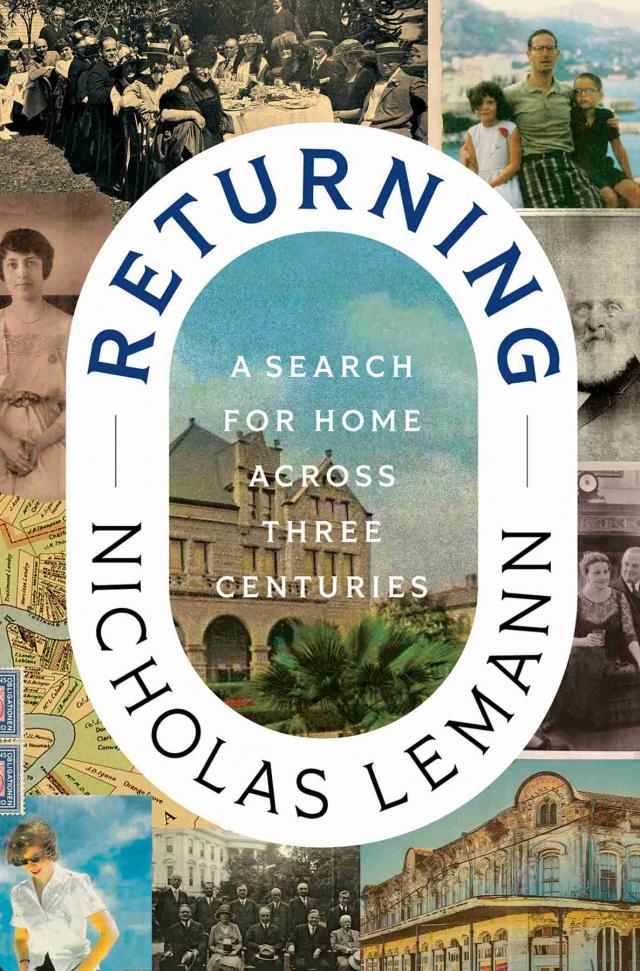


RETURNING
A SEARCH FOR HOME ACROSS THREE CENTURIES
NICHOLAS LEMANN
The family grave where Bernard and Harriet Lemann, and many other family members, are buried, Metairie cemetery, New Orleans. Linda Reno
For Judith
Contents
THE LEMANN FAMILY TREE
•
Leaving
Arriving
Returning
•
ACKNOWLEDGMENTS
A NOTE ON SOURCES
INDEX
The Lemann Family Tree
Follow for extended description
Part One
Leaving
Palo Alto plantation, just outside Donaldsonville, painted by Marie Adrien Persac in the 1850s.
The summer I was nineteen years old, I had two jobs in New Orleans. One was working as a reporter for what we used to call an underground newspaper, the Vieux Carre Courier, whose office was in a spare, dusty loft at the back end of the French Quarter. The other was assisting someone who had gotten a grant to write a history of a briefly flourishing New Orleans literary magazine of the 1920s called The Double Dealer, also located in the French Quarter, which had been early to publish William Faulkner, Ernest Hemingway, Allen Tate, and Robert Penn Warren. It was 1973. Some people who’d been fifty-years-ago versions of me, young people working at The Double Dealer or at least in its orbit, were still alive. My job was to find them and interview them. I spent the summer ping-ponging between the present (the Courier) and the past (The Double Dealer), between journalism and history, between political crusading and literary sleuthing.
It was inevitable that I would end up in the study of Ben C. Toledano that summer. Ben C. (never Ben) was news in the present, a Republican back when they were rare in New Orleans, who frequently ran unsuccessfully for office. He was also New Orleans’s leading collector of Southern literature: the study, cool, kept in semidarkness to protect the books, was lined from floor to ceiling with signed first editions of the work of every Southern novelist who was even moderately well-known. Ben C. was someone whose political life was based on accusing the establishment of being corrupt—by his lights, if not many other people’s, too liberal—so he was a font of advice about what shady arrangements I ought to look into. He also knew everybody in town who might have something to say about The Double Dealer.
On one of my visits, Ben C.—disinhibited, dough faced, with a stiff, pomaded stand of iron gray hair, dressed as usual in a white shirt so stiffly starched that it could have stood up on its own without him in it—walked me around the four walls of the study, plucking books out here and there, telling me where he’d found each one and how he’d gotten it signed. He accompanied his narrative of acquisition with gossipy anecdotes and brief reviews. He arrived at the culmination of the tour: what he considered the greatest of all Southern novels, Warren’s All the King’s Men (to the ever-familiar Ben C., the author was Red Warren). I hadn’t read it, even though it was set in an unnamed state that was obviously Louisiana, where Warren had taught at the state university through most of the 1930s and had watched at first hand the rise and fall of our dictatorial populist governor, Huey Long. Ben C.’s endorsement sent me straight to the Basement Book Shop, housed in an ancient, askew yellow shotgun house, whose grouchy and opinionated owner, Tess Crager, had known the Double Dealer crowd back in the 1920s, to buy a copy. Mrs. Crager often forbade her customers, at least the ones like me whom she knew, to buy books they asked about, because she thought they were junk, but in this case she gave her consent.
Some books change your life because they lead you to experience the world in a new way. Others lend a kind of grandeur to the life you’re already living, the life that you may sometimes think of as mundane or futile or insignificant, much as you don’t want it to be. That was All the King’s Men for me. Written in a lush, consciously poetic prose that you don’t encounter so often anymore in American literary fiction, it elevates politics to the level of myth: hubris, doomed love, domination, tragedy, betrayal, murder, suicide, revelation. The pertinence to my own situation was obvious. Jack Burden, the narrator, was the lonely, searching, discontented scion of a prominent Southern family, more strongly drawn to observation than to action. So was I. He was torn between loyalty to the place he came from and an impulse to overturn its social order. So was I. He did historical research and journalism—both grounded in a need to investigate things you aren’t supposed to know. So did I. In particular, he wound up spending a great deal of time looking in old family records. And so did I—though that came much later. In All the King’s Men, all this was vastly consequential. Therefore I could take it as a demonstration that my own preoccupations were more than merely passing adolescent enthusiasms.
In the South, the supreme event between the time All the King’s Men was published in 1946 and the time I read it was the public peak of the civil rights movement—something the novel in no way anticipates. Another book that was a touchstone for me in those days was The Burden of Southern History, by C. Vann Woodward. (It’s dedicated to Robert Penn Warren.) Woodward wrote history for Southern liberals, in which the Jim Crow regime represented a terrible wrong turn, not the essence of the region. The South could have, should have, moved beyond its feudal economic system, but appeals to race solidarity had distracted the attention of its plain people, to their eventual sorrow—especially if they were Black, but even if they were white. It was this version of Southern history that Martin Luther King Jr., who’d obviously read Woodward, offered up in his magnificent speech on the steps of the Alabama State Capitol at the end of the Selma to Montgomery march in 1965.
Besides Jack Burden, another literary figure I identified with was Faulkner’s Quentin Compson, who, at the end of Absalom, Absalom!, as a student at Harvard (as I too was that summer), having recounted the long and terrible Southern history of his own family, is left shouting helplessly, “I dont hate it! I dont hate it!” Woodward offered a way not to hate the South, if its being your home made that painful. You could see its past as a series of tragic mistakes—and, in the present, you could hope that the South, as the only region of the country fully acquainted with defeat and failure, could lead America out of its self-deluding preoccupation with triumphant success, into a more realistic form of consciousness. I was ready to enlist as a soldier in that mission.
Another thing I remember about my visits to Ben C. was that he was preoccupied with my being Jewish. Every time I came to visit he brought it up. He loved being transgressive, and in that time and place you weren’t supposed to talk about such things. Jews in New Orleans were a tiny group, whose status felt eternally provisional, dependent on our being unobtrusive. Having it brought up made me uncomfortable—most people were discreet enough not to. Anyway, a Southerner was what I was. But Ben C. would obsessively offer up lists of who in New Orleans was Jewish, who didn’t want people to know they were Jewish, who was too Jewish, who might or might not be Jewish. In that last category he put himself. Toledano is a standard name for Sephardic Jews, referring to Toledo, the Jewish center of medieval Spain. The C. in Ben C. was for Casanas, his mother’s name before she married—also possibly Sephardic. In the way that there was always gossip in the world I grew up in about who might have “a touch of the tarbrush,” meaning that they were Black and passing, Ben C.’s mother was known, as he liked to tell me, as the Jewish Queen of Carnival—in the present, an impossibility—because she had been a member of the city’s one-day reigning couple on Mardi Gras in 1929, and . . . people wondered. He could talk to me about these things because he knew that my own family had a similar liminal status in New Orleans.
On the Jewish calendar, it was 5733, not 1973. History is longer and slower to unfold when enumerated in that way. My great-great-grandfather, Jacob Lemann, born and raised in the village of Essenheim, Germany, arrived in New Orleans as a young man, alone, in 1836. In Jewish-American time, that was long ago, making us an old family. In unhyphenated Jewish time, Jacob came here in 5596. The time between then and now feels to me like merely a moment in Jewish history. Jacob was born in 1809, at a time when his village in Germany was under the dominion of France. Just a few years earlier the French emperor, Napoleon Bonaparte, had made Jews citizens. It was astonishing that Jews could be understood, even by themselves, as anything but an entirely separate tribe, enclosed, self-governing, barred from living in most places or working in most occupations; mysterious, fetishized, feared, and despised by outsiders; only hazily aware themselves of what the non-Jewish world was like. Napoleon soon backpedaled: for Jews to become full members of society, they had to become normal by non-Jews’ lights, for example by giving up their traditional occupation of moneylending and by adopting conventional first and last names. And soon after that, he fell from power and the part of Germany he no longer controlled began reinstituting the traditional restrictions.
Jacob was part of a small but coherent Jewish migration from the Upper Rhine River Valley—southwest Germany and Alsace—to Louisiana. What drew these people to this destination was that it was an unusually prosperous place, where the traditional Jewish skills could find a ready market and there were no official rules telling Jews what they could and couldn’t do. Perhaps they felt that something that had long eluded Jews could be achieved there. But the reason Louisiana was so prosperous was that it was one of the world’s principal locations for producing sugar, on cane plantations that were home to a particularly harsh form of slavery—the escape from which is central to our own mythology. Jacob, illiterate i n English, quickly and steadily made his way upward in this setting. He married a teenage girl, Marie Berthelot, a Cajun, also illiterate in English. Twenty years into their American life, they began relocating to New York City. Marie converted to Judaism. Their firstborn child, Bernard, my great-grandfather, was by his late twenties an enthusiastic consumer of high culture—literature, opera, theater—and an observant Jew.
When the Civil War began, the family chose to leave the country temporarily and return to Germany. When the war ended, they returned to Louisiana rather than New York. They used the postwar chaos of the Deep South as an opportunity to acquire a string of plantations in sugar country. Bernard, the young aesthete, became a merchant and a midlevel agricultural baron. He and his wife, Harriet Friedheim, were leading members of the Jewish community, and parents of ten children, eight of whom survived to adulthood, four of whom they sent to Harvard to be educated. One of these was my grandfather, Montefiore Mordecai Lemann, who grew up to become a prominent lawyer in New Orleans, and, along with his wife, Nettie Elise Hyman, a full participant in the social and political life of an American German-Jewish elite that had its heyday in the first half of the twentieth century and has since evanesced, thanks to assimilation, intermarriage, and conversion.
My parents, Thomas and Barbara London Lemann, the fourth American generation of the family, aspired to become fully mainstream—still Jewish but in ways that entailed no particularity in how we conceived of ourselves and how we lived, finally freed of the restrictions that, despite their not officially ever existing in America, had somehow never stopped reappearing. It was unmissable that I came from a plantation-owning family and that I was being raised in a race-pervaded culture, in which one couldn’t get through even a few hours of an ordinary day without being reminded that white supremacy was the prevailing order. That explains why, at the time of my encounters with Ben C. Toledano, I thought of myself as a Southerner, and also why I had fastened on the civil rights movement, something that people in homes like ours were aware of as an approaching force that proposed to change our way of life, as a means of remaining loyally Southern without having to retain whites’ traditional sense of what that entailed.
Being Jewish was far more mysterious to me. I knew almost nothing about the Jewish aspect, as opposed to the Southern aspect, of my family’s history. It was more the way other people, like Ben C., thought of us, than the way we thought of ourselves. Why couldn’t it be a lightly held and inconsequential ethnic identity, something a little quaint or exotic, adding a touch of spice, but nowhere near life-determining in the way that racial identity was in our world? I knew that some time when I was a small child, a member of our family had taken on a research project that ended in his depositing a large collection of material—records, letters, diaries—in the manuscript collection at Tulane University, just a few blocks from our house. Much as I was coming to discover that I loved investigating, looking at these family papers was one investigation I made a point of not undertaking. Present-day political machinations and misdeeds, and the literary history of New Orleans, were far more compelling. Maybe I was afraid of what the family papers would reveal: a past I wouldn’t be proud of. It wasn’t until decades later, and a lifetime of investigating everything but this, that I decided it was time to look. Now I’m going to tell you what I discovered, not just about the people I come from, but also about myself. What my original exemplar of investigation, Jack Burden, said at the end of All the King’s Men also applies to me, I think: “It is the story of a man who lived in the world and to him the world looked one way for a long time and then it looked another and very different way. The change did not happen all at once.”
Palo Alto
In All the King’s Men, Jack Burden periodically visits his family’s elegant rural homestead, in a place called Burden’s Landing. For me the equivalent is Palo Alto plantation, a short distance outside the town of Donaldsonville, Louisiana, where my family has lived for 180 years. (To make the comparison to Burden’s Landing more exact, there’s a nearby hamlet called Lemannville.) There is a dreamy picture, rendered in soft light blues and greens, of Palo Alto, made some time shortly after it was built, before my family owned it. The artist, Marie Adrien Persac, a French-born architect and draftsman, traveled through sugarcane plantation country in the years before the Civil War, making flattering images of houses on commission from their owners.
In the picture, a small white-sailed schooner sails lazily along calm, broad, pacific Bayou Lafourche. Gentlemen in stovepipe hats and ladies in elegant dresses stand on the opposite bank, looking across the bayou at the plantation. Palo Alto itself is a complex of several buildings enclosed by a picket fence. A horse and buggy passes by on the road. In All the King’s Men, Burden’s Landing, a coastal town, plays as an instantiation of the kind of economic class system that gave rise to populists like Huey Long. It’s impossible to see Palo Alto in that way: it’s deeply, inextricably embedded in slavery. Persac’s drawing comes across as a typical antebellum Southern planter’s version of plantation life as a pastoral idyll. There are only white people in the picture, but the evidence of how the place operated is there: next to the columned main house are a sugarhouse, a shed, an overseer’s house, a double row of slave cabins. Palo Alto means “tall tree” in Spanish: that’s pastoral too. But the name is actually a tribute to a military triumph, the battle at Palo Alto in 1846, the first major encounter of the Mexican-American War, just before construction of the plantation began. The name indicates a practical project, a dream of conquest, behind the elegant scrim represented by the pretty moniker.
I still visit Palo Alto every so often. My cousin Peter lives there with his partner, DeeDee DiBenedetto, who’s descended from Sicilian laborers who were imported by Louisiana planters after emancipation to work on the sugar plantations. (One of the old country lanes that runs through Palo Alto’s cane fields is called Dago Road, after the planters’ favored epithet for Italian immigrants.) DeeDee is an ex-Marine, an ex-police officer, a private investigator, a local historian, and an expert on paranormal phenomena—she insists that the ghost of one of the nineteenth-century Lemanns patrols the grounds at Palo Alto.
When I was growing up, we would make regular trips to Palo Alto so that we could understand where we came from. In those days Peter’s parents, Bubs (my father’s first cousin) and Camille, he in a seersucker or linen suit, she in a light sundress with her hair pinned up in a bun, presided over the plantation. They kept pet peacocks that wandered around behind the house. They’d show us how to milk cows and to harvest eggs from the henhouse and give us sticks of fresh sugarcane to suck on for a treat. The house was pervaded by the past. The windows, of wavy old glass, had people’s names scratched into them, supposedly with diamonds from engagement rings. The rooms, full of old, heavy wood furniture, were still, hot, with tall ceilings and plaster walls. In the attic there were boxes filled with old pictures of stiff-looking people taken a very long time ago, and handwritten ledger books that recorded ancient transactions in an elaborate script. There was a small dungeon underneath the house, a reminder of slave times. Sometimes Bubs would pull my father aside to have a private conversation about something children weren’t supposed to know about.
Today Palo Alto is a plantation, a bed-and-breakfast, a rentable wedding venue, a shooting range, a hunting lodge, and a right-of-way for underground oil and gas pipelines. Most of the nearby plantations stand empty; keeping the place going requires a good deal of effort. Sometimes Civil War buffs with metal detectors come by and ask Peter and DeeDee for permission to hunt for spent bullets, out in front of the house where the saplings in Persac’s picture are now broad old oak trees, hung with Spanish moss, which keep the grounds in a deep shade. A lightly used county road runs along the bank of the bayou, some distance in front of the house. On the broad front porch, where Peter likes to sit in a rocking chair smoking a pipe, it’s quiet. You don’t feel very closely connected to the world as it is now.






